BaZi Element Compatibility: How to Compare the Five Elements Between Two Charts
A clear, method-driven guide to analyzing element interactions between two BaZi charts. Learn the productive, controlling, and weakening cycles and how to apply them without overclaiming.
When people first encounter BaZi, one of the most natural questions they ask is whether two charts are “compatible.” You might be curious about a relationship, a business partnership, or simply want to understand the dynamic between your own chart and someone else’s. This article provides a clear, structured approach to comparing the element profiles of two BaZi charts using the framework of the Five Elements. It does not promise definitive answers about relationship outcomes, but it does offer a meaningful reading path grounded in the classical cycles.
The Foundation: How the Five Elements Interact
Before comparing two charts, you need a solid grasp of how the Five Elements—Wood, Fire, Earth, Metal, and Water—relate to one another. These relationships are the lens through which we read compatibility. There are three fundamental cycles that matter most for a pairwise comparison.
The Productive (Generating) Cycle
In the productive cycle, one element feeds or generates another. The sequence runs: Wood produces Fire, Fire produces Earth, Earth produces Metal, Metal produces Water, and Water produces Wood. When we see this cycle between two charts, it suggests a supportive, nourishing dynamic. For example, if Person A’s chart is heavily Wood and Person B’s chart is strongly Fire, the interaction may feel encouraging—like one person’s energy naturally fuels the other’s.
Example: Imagine a Wood Day Master person whose chart also contains strong Water and Wood. Their Wood is well-supported. When they meet a Fire Day Master, the productive pathway from Wood to Fire can create an environment where the Wood person’s ideas or presence help ignite the Fire person’s expression. The Fire person may feel more expressive and active.
The Controlling (Restraining) Cycle
In the controlling cycle, one element acts upon another to keep it in check. The sequence: Wood controls Earth, Earth controls Water, Water controls Fire, Fire controls Metal, and Metal controls Wood. Unlike the productive cycle, this is not inherently negative. A healthy controlling dynamic can bring structure and balance—like a framework that prevents excess. However, when forces are mismatched, it may feel like friction or suppression.
Example: If Person A has a dominant Earth Day Master with additional Earth and Fire in the chart, they may have a very grounded, stabilizing presence. Person B, with a Water Day Master and a weaker overall chart, might feel their fluidity constrained by the Earth person’s weight. In a balanced interaction, the Earth person can provide a container for the Water person’s creativity, but when the Earth is too strong, the Water may feel dammed up.
The Weakening (Exhausting) Cycle
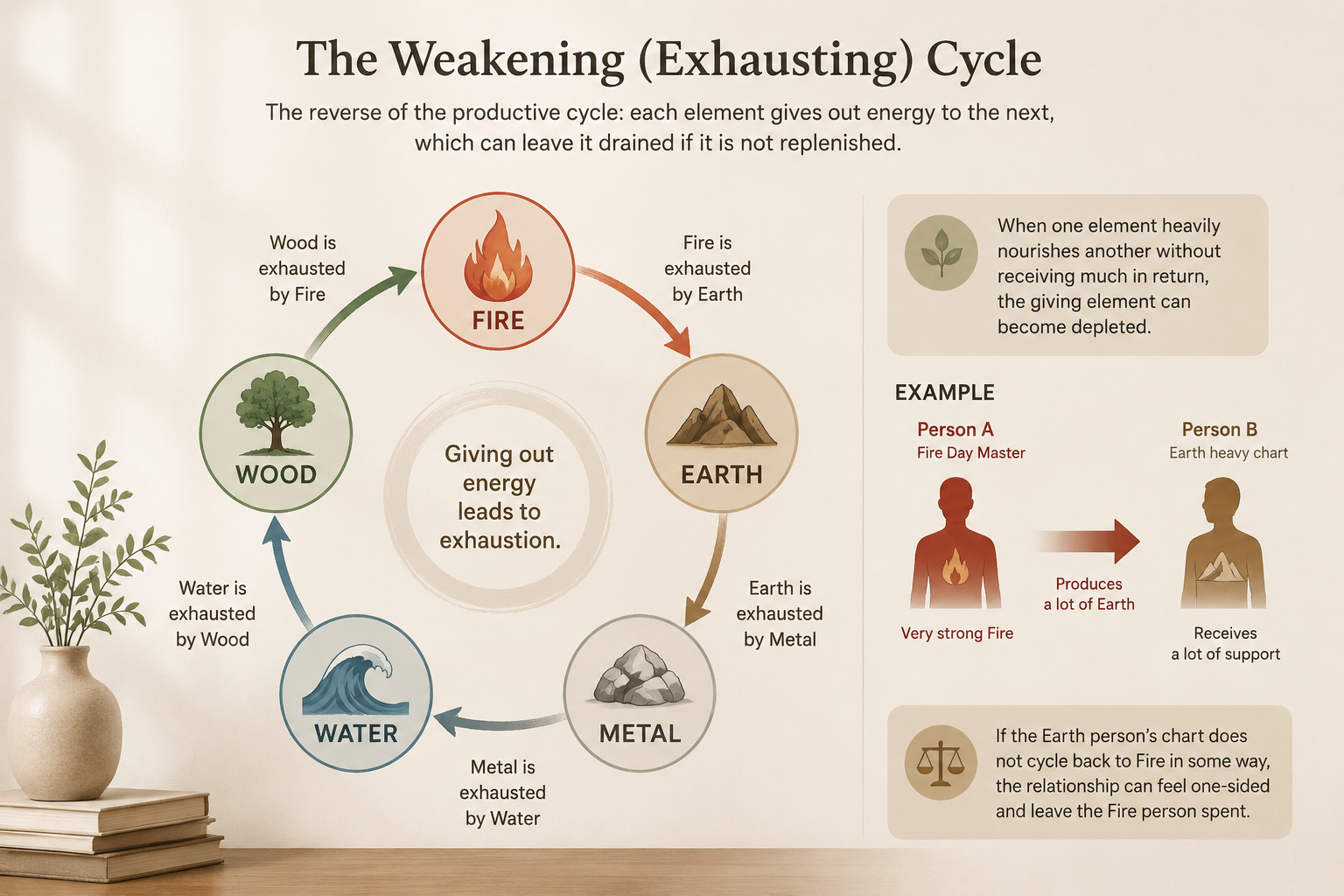
The weakening cycle is the reverse of the productive cycle: Wood is exhausted by Fire, Fire by Earth, Earth by Metal, Metal by Water, and Water by Wood. When an element produces another, it gives out energy, which can leave it drained if it is not replenished. This often appears when one chart heavily nourishes another without receiving much in return.
Example: A Fire Day Master person with very strong Fire that produces a lot of Earth (their own expression and output) may find that interacting with a very Earth-heavy chart leaves them feeling spent. The Fire person might give a lot of support, but if the Earth person’s chart does not cycle back to Fire in some way, the relationship can feel one-sided over time.
How to Compare Two BaZi Charts: A Step-by-Step Path
Comparing element interactions between two charts is more than just checking Day Master elements. It is a methodical process that looks at the overall element distribution, the Day Master’s strength, and the dynamic between the two sets of stems and branches. Here is a systematic way to approach it.
Step 1: Identify the Day Master of Each Chart
The Day Master is the Heavenly Stem of the day pillar and represents the person’s core self. Begin by noting the element and polarity (yang or yin) of each Day Master. For example, a Yang Wood Day Master versus a Yin Fire Day Master. Understanding the Day Master’s element is the starting point, not the whole story.
Step 2: Assess the Overall Element Weight of Each Chart
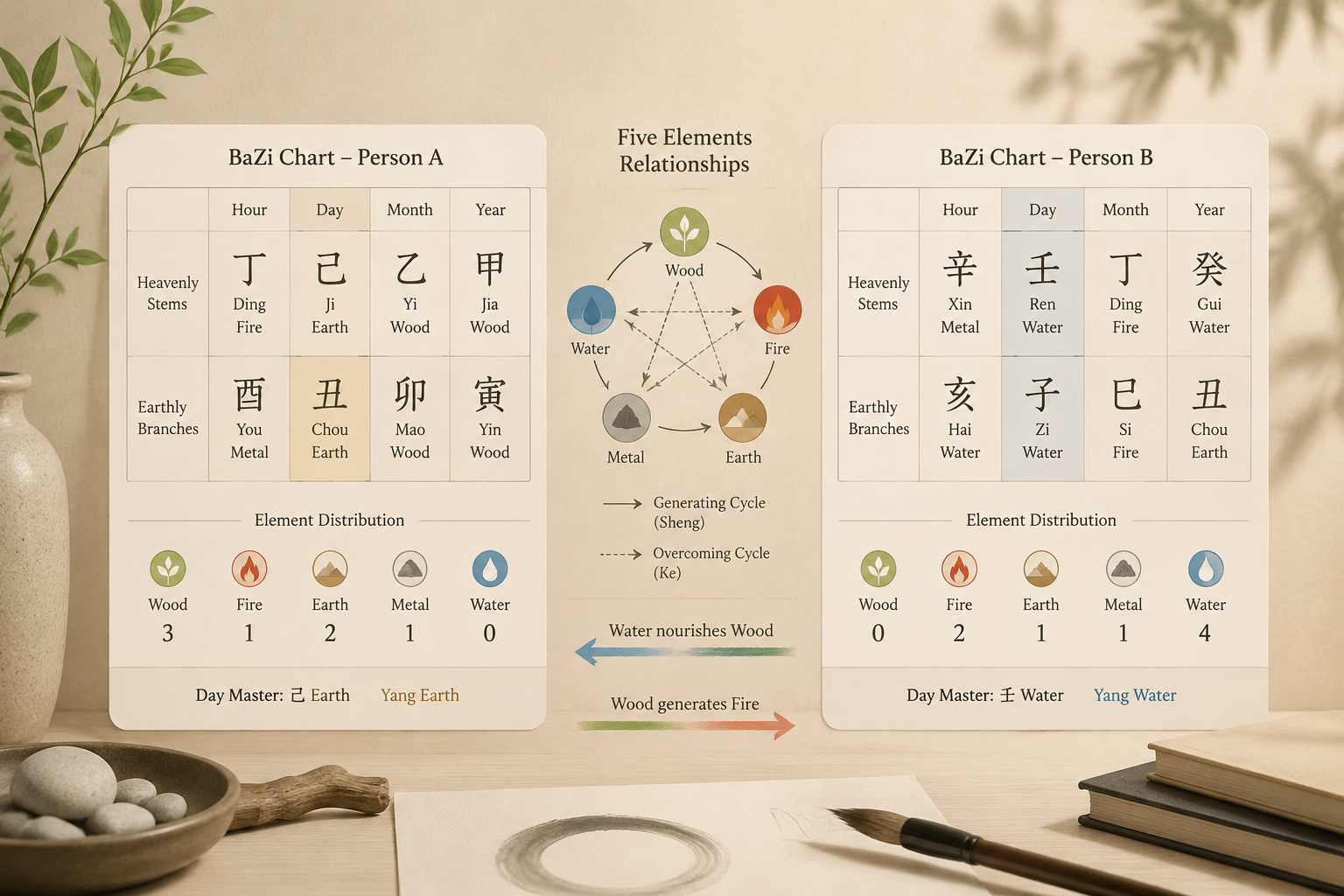
A BaZi chart contains four pillars, each with a Heavenly Stem and an Earthly Branch, which holds hidden stems. Count the appearance of each element across all eight characters (and the hidden stems if you want a deeper analysis). This gives you a profile: some charts are heavily biased toward one or two elements, others are more balanced.
Why this matters: Even if two Day Masters are in a productive cycle, if one chart is overwhelmingly dominant in the producing element and the other is very weak in the receiving element, the dynamic may be overwhelming rather than supportive. The method invites you to look at proportion, not just type.
Step 3: Map the Key Interaction Pathways
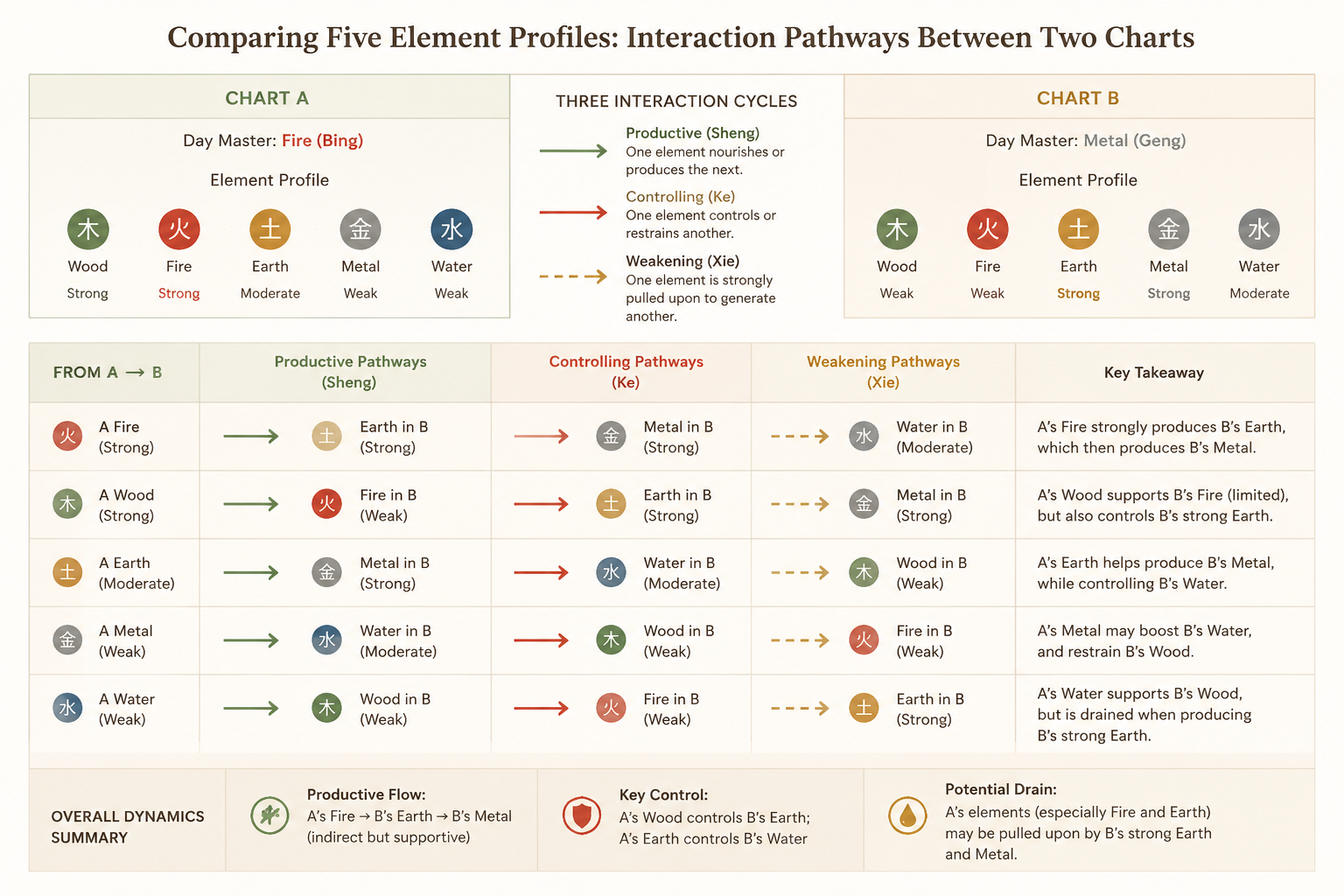
With element profiles in hand, overlay the three cycles:
- Productive pathways: Where elements in Chart A feed elements in Chart B, and vice versa.
- Controlling pathways: Where Chart A’s elements control or restrain elements in Chart B.
- Weakening pathways: Where one chart is strongly pulled upon to generate the other’s dominant elements.
Consider both the Day Master and other prominent elements. For instance, if Chart A has a Fire Day Master and strong Wood, while Chart B has a Metal Day Master and strong Earth, note that Chart A produces Earth (Fire produces Earth), which then produces Metal in Chart B. So there is an indirect productive path: Fire → Earth → Metal. Meanwhile, Metal controls Wood, so there is a controlling path from Chart B’s Metal to Chart A’s Wood.
Step 4: Evaluate Support and Friction Patterns
A healthy interaction often shows mutual productive support, where each chart provides something the other lacks, without heavy conflict. When you see a lot of controlling cycles, look at the relative strengths. A moderate controlling dynamic can be constructive—like a mentor who sets boundaries. But if one chart’s controlling element is overwhelming and the other’s controlled element is a key part of their Day Master or supporting structure, the dynamic may create constant tension.
Reading Tip: Check the “useful god” (yong shen) concept if you are familiar with it. If the useful god of one chart is strengthened by the other chart, the interaction tends to feel beneficial. Conversely, if the other chart strengthens the “annoying god” (ji shen) or damages the useful god, the dynamic may be challenging.
Step 5: Consider the Luck Pillars Timing
Two charts that look harmonious on paper might not feel that way at certain points in life if one person’s current Luck Pillar amplifies difficult interactions. A responsible reading acknowledges that compatibility is not static. A comparison gives a snapshot; the actual lived dynamic shifts as each person moves through their Luck Pillars. This is one reason why the method stops well short of predicting the success or failure of a relationship.
What Element Compatibility Can and Cannot Tell You
Element compatibility is a descriptive method, not a deterministic one. It can help you:
- Identify potential areas of natural support or friction.
- Understand why certain interactions feel easy or effortful.
- Frame conversations about how two people might approach tasks, communication, or conflict.
It cannot guarantee relationship outcomes, financial success, or the depth of personal connection. Many other factors—life experience, communication skills, mutual respect—shape any relationship. Use element compatibility as one lens, not the final word.
Frequently Asked Questions
Is it enough to just compare the Day Masters?
Comparing Day Masters alone gives an overly simplistic view. The Day Master is a starting point, but the full element distribution, hidden stems, and the interaction between all pillars create the real picture. A Wood Day Master and an Earth Day Master might theoretically have a controlling dynamic, but if both charts contain a lot of Water, the dynamic may be more cooperative than expected.
What if my chart and another chart show a lot of controlling cycles?
Controlling cycles are not inherently bad. They can indicate a dynamic of mutual refinement, where each challenges the other to be better. However, if the controlling elements are extreme or if one chart is much stronger, it can feel oppressive. It’s useful to look at the whole picture and ask: is there also productive support somewhere? Often relationships have a mix of cycles.
Can element compatibility change over time?
Yes, because each person’s Luck Pillars bring new energy that can amplify or mitigate certain interactions. A relationship that starts with a lot of productive flow might enter a phase where a new Pillar introduces controlling energy, requiring adjustment. The method is dynamic, not fixed.
Should I use this to decide whether to enter a relationship?
This article is a cultural reference tool, not relationship advice. The BaZi element compatibility reading offers insight into elemental dynamics, but it does not capture the full human experience. Use it for reflection, not decision-making.
Applying the Method with Free BaZi
To get the most out of element compatibility reading, you first need accurate, clearly presented charts. Generate your own BaZi chart, then use it as the basis for comparing with a partner’s chart. The Free BaZi chart tool calculates the Day Master, displays element distributions, and provides a clean view of the stems and branches, making side-by-side comparison straightforward.
Once you have both charts, you can draw out element profiles, map the cycles, and note the patterns described in this guide. Remember that the reading is only as useful as the clarity and restraint with which you hold it. The Five Elements offer a profound cultural framework for understanding dynamic forces—not a verdict on anyone’s life.
Related reading
Related guide
Ten Gods in BaZi: What Each One Means in Your Chart
A methodical guide to the Ten Gods in BaZi: how they arise from the Day Master, what each represents, and how to read them in context using the Free BaZi chart tool.
Related guide
BaZi Compatibility Reading Boundaries
Learn how BaZi compatibility reading works through the structured method of Day Master interaction, Five Elements, and Ten Gods—with clear boundaries and no promises.
Related guide
BaZi Luck Pillars: How the 10-Year Cycles Shape Your Life
A methodical introduction to luck pillars in BaZi: how the 10-year cycles are structured, how to read them with your natal chart, and why they offer an interpretive layer, not a fixed prediction.