What Is Four Pillars BaZi? How to Read a BaZi Chart
Four Pillars BaZi explained: the four pillars, Heavenly Stems, Earthly Branches, the Day Master, the Ten Gods, and a step-by-step way to read a BaZi chart.
Four Pillars BaZi turns a birth moment into four pairs of characters — year, month, day, and hour — and reads those eight characters as a structured set of relationships. It is a cultural reference system and a method for reflection, not a fixed verdict about a life. This guide explains the vocabulary, the reading order, and the limits of the method.
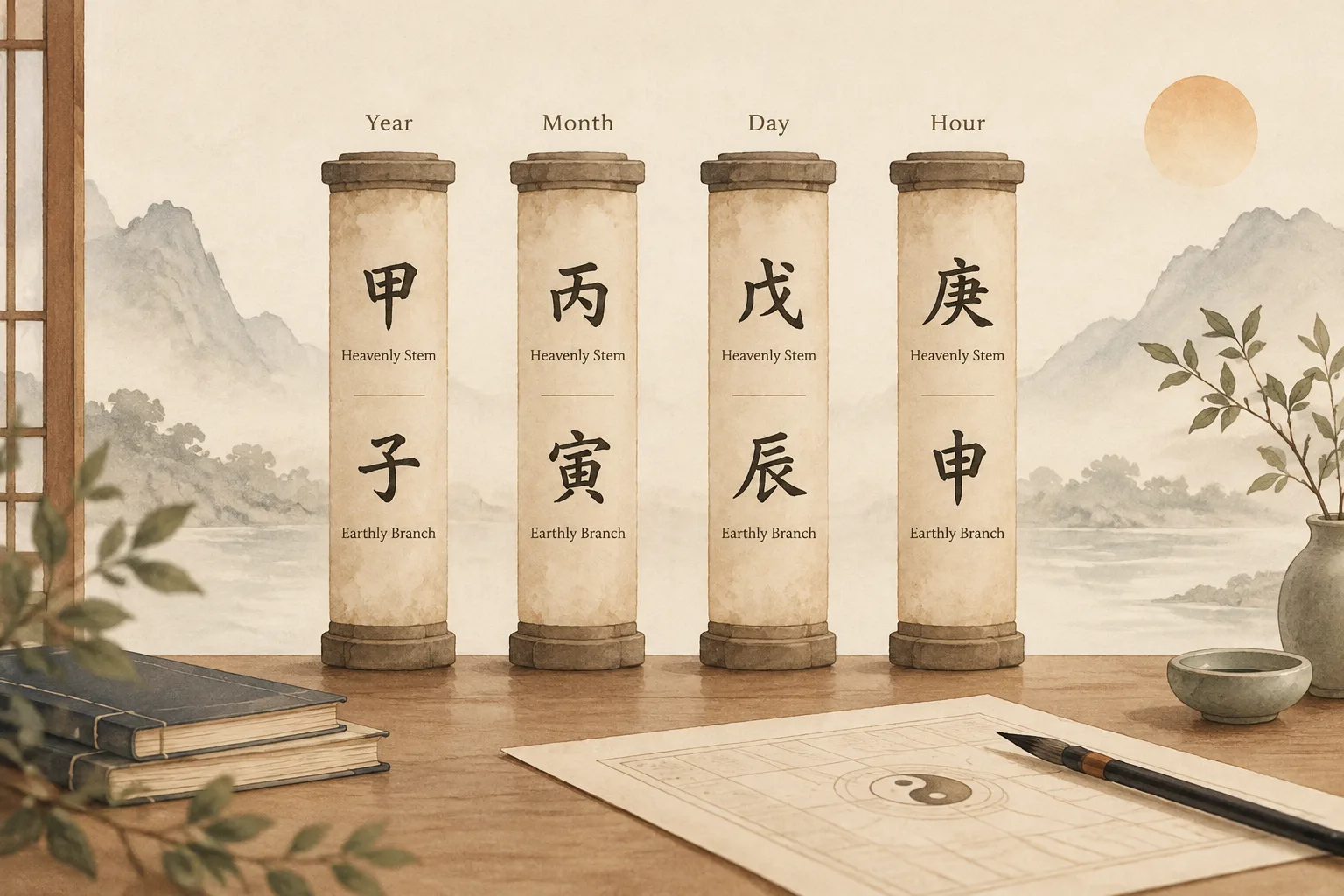
Why the Name Means "Eight Characters"
Each pillar contains two characters: a Heavenly Stem above an Earthly Branch. Four pillars therefore give eight characters, which is the literal meaning of BaZi. The framework is also translated as Four Pillars of Destiny, though "destiny" overstates what the method delivers — it describes tendencies, seasons, and relationships among elements rather than a script.
A chart is also read in layers: element balance, Day Master strength, the Ten Gods, and timing cycles. Keeping that layering in mind prevents a single label from being mistaken for the whole picture.
The Four Pillars and What Each One Represents
The four pillars are usually drawn side by side, from year on the left to hour on the right.
- Year pillar — the birth year in the sexagenary cycle. Traditionally read as background, generation, and early environment.
- Month pillar — set by solar terms rather than by the calendar month. Because it carries the season, it is often weighted most heavily when judging element strength.
- Day pillar — its stem is the Day Master, the reference point for the entire chart. Its branch is traditionally associated with the closest relationships and the private self.
- Hour pillar — one of twelve two-hour segments, linked in traditional readings to later life, children, and inner aims.
A common metaphor compares the pillars to a tree: year as roots, month as trunk, day as flower, and hour as fruit. The metaphor is useful precisely because it is relational — no single pillar stands alone.
Heavenly Stems, Earthly Branches, and the Five Elements
Ten Heavenly Stems and twelve Earthly Branches combine into a sixty-term cycle that repeats. Every stem and branch carries one of the Five Elements — Wood, Fire, Earth, Metal, Water — plus a yin or yang polarity.
Branches also contain hidden stems, so one branch can hold two or three elements. This is why two charts with similar visible elements can still read differently. Strength is judged seasonally: Wood in spring behaves differently from Wood in autumn. Solar terms mark those seasonal boundaries and determine the month pillar, which is why the month is treated as the climate of the whole chart.
The Day Master: The Reference Point of the Chart
Every other character is described relative to the Day Master: what supports it, what drains it, what it controls, and what controls it. A first reading question is whether the Day Master is well supported by the season and rooted in the branches, or relatively exposed.
A Wood Day Master born in a water-rich winter month sits in a different setting from one born in a dry late-summer month. Seeing this reference point clearly is the starting line for any further reading. You can view it immediately with a free BaZi chart tool, which labels the Day Master in the generated chart.
The Ten Gods: How a Chart Describes Relationships
The Ten Gods are labels produced by comparing each character's element and polarity with the Day Master. Five element relationships — same element, generates me, I generate, I control, controls me — each split by polarity give ten names.
They describe broad categories of experience: peers and siblings, resources and learning, output and expression, wealth and management, authority and structure. These are interpretive lenses, not fixed events. A chart weighted toward one category suggests a recurring theme, not a guaranteed outcome.
How to Read a BaZi Chart, Step by Step
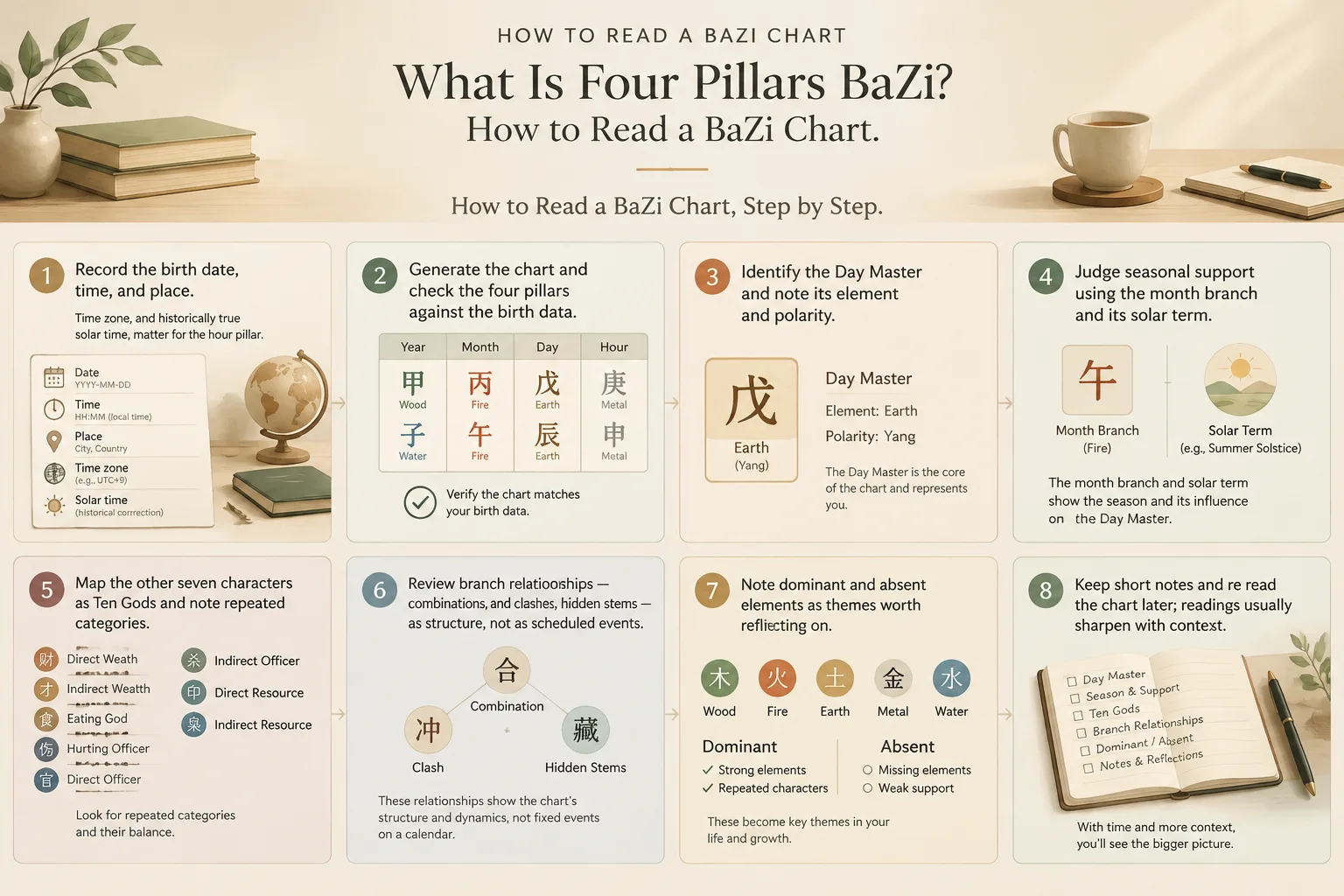
- Record the birth date, time, and place. Time zone, and historically true solar time, matter for the hour pillar.
- Generate the chart and check the four pillars against the birth data.
- Identify the Day Master and note its element and polarity.
- Judge seasonal support using the month branch and its solar term.
- Map the other seven characters as Ten Gods and note repeated categories.
- Review branch relationships — combinations, clashes, hidden stems — as structure, not as scheduled events.
- Note dominant and absent elements as themes worth reflecting on.
- Keep short notes and re-read the chart later; readings usually sharpen with context.
Luck Pillars and the Huangli Calendar
Beyond the four pillars, many readers look at Luck Pillars: ten-year segments that each carry their own stem and branch, followed by annual pillars. They are read as changing context around a fixed chart, the way a season changes the setting for a plant.
The Huangli calendar works at a finer scale, giving the day's stem and branch along with traditional notes on suitable and unsuitable activities. Both are cultural reference tools; neither turns a chart into a schedule of certain events.
What a BaZi Reading Can and Cannot Do
BaZi offers a consistent vocabulary for describing temperament, timing, and relationships in symbolic terms. It cannot verify medical, financial, or legal outcomes, and it should not be used in place of qualified professional advice.
Two people with identical charts can live very differently, because environment, choices, and chance are not contained in the chart. A careful reading states its assumptions, separates observation from interpretation, and avoids fear-based framing. Used that way, BaZi works as a mirror for reflection and as an entry point into a long-standing cultural tradition.
FAQ
What is Four Pillars BaZi in plain terms?
It is a method that writes a birth moment as four pairs of characters — year, month, day, and hour — and reads the resulting eight characters as related elements, with the day stem as the reference point for everything else.
Do I need an exact birth time?
For the hour pillar, yes. Without a reliable time, three pillars can still be read, but the hour pillar and some timing analysis are left out. Treat any hour-based conclusion as provisional.
Is BaZi the same as the Chinese zodiac?
Partly. The zodiac animal comes from the year branch alone, which is one of eight characters. BaZi adds month, day, and hour, plus stems, elements, and the Day Master, so it describes considerably more.
Which pillar matters most?
The day pillar usually anchors a reading because its stem is the Day Master. The month pillar is often weighted next, since it carries the season. Which one matters most also depends on the question being asked.
Can a BaZi chart predict the future?
It describes patterns and cycles in symbolic language. Reading it as a forecast of specific events goes beyond what the method can support. It is better used to frame questions and reflect on tendencies.
What are the Ten Gods used for?
They label how the other characters relate to the Day Master, which helps organize a reading into themes such as support, expression, resources, and structure rather than a list of disconnected symbols.
Start With Your Own Chart
Ready to look at a real chart? Generate one with the free BaZi chart tool and read it alongside the Huangli calendar for day-level reference.