Useful Gods in BaZi: Understanding Yong Shen and Structural Balance
A calm, method-driven guide to identifying and interpreting the Useful God (Yong Shen) in BaZi. Learn how Day Master strength, seasonal influences, and element interactions shape the reading of structural balance.
Useful Gods in BaZi (用神, yòngshén) are a structured way to name what a chart may need for balance. In Free BaZi’s reading path, they are not magical agents and not a promise about outcomes. They are labels for elements, stems, branches, or Ten Gods roles that appear to support, regulate, or relieve pressure on the Day Master once strength, season, and structure are assessed.
This wiki explains the concept, the usual decision path, common misreads, and how to inspect the idea inside a transparent BaZi chart workflow.
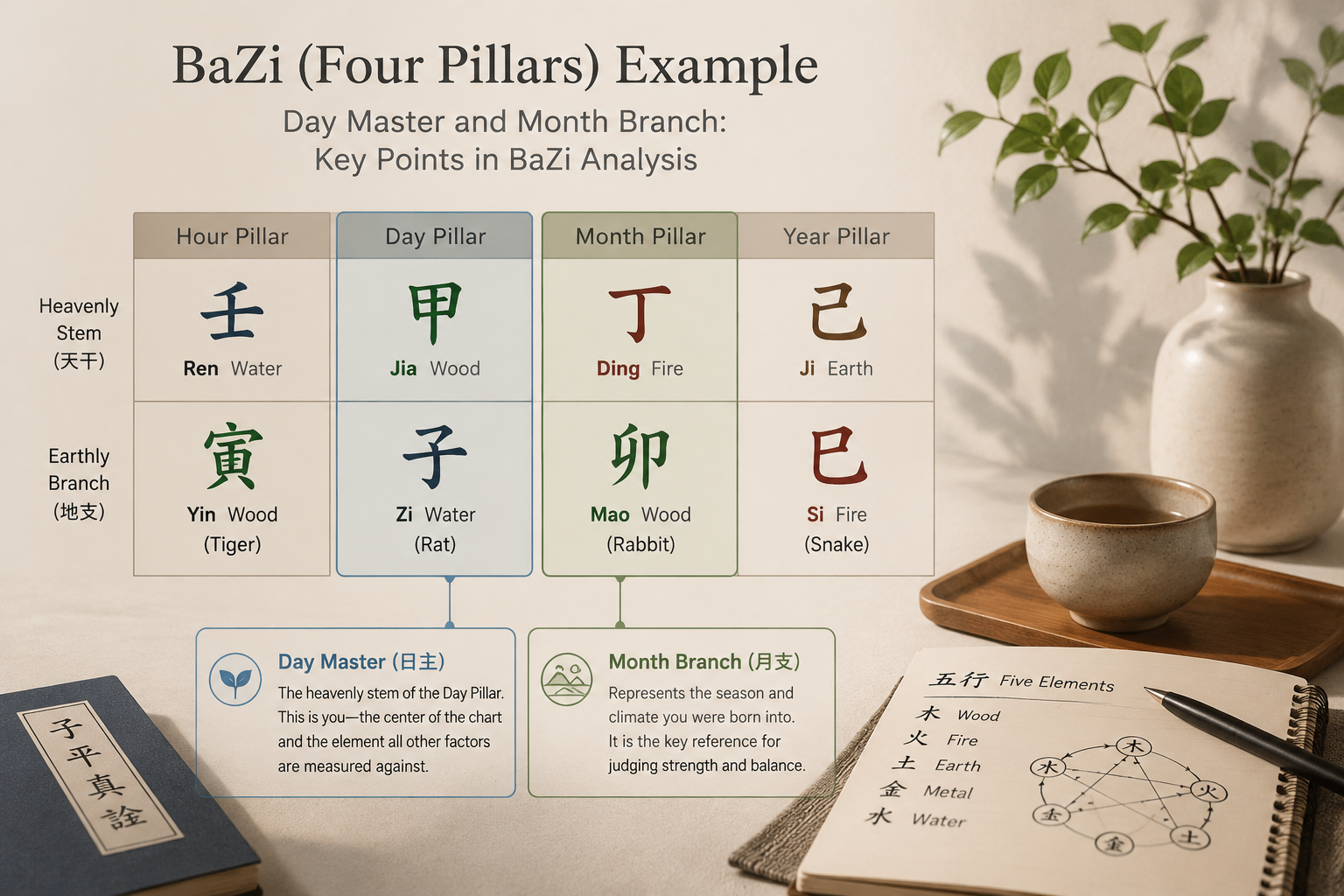
What “Useful God” means in method terms
Classical and modern BaZi schools use “Useful God” as shorthand for the factor that most usefully rebalances the chart’s main tension. The word “god” is a historical translation habit; in practice you are ranking functional roles among the Five Elements and the Ten Gods.
A restrained definition:
- Start from the Day Master (the day stem).
- Judge relative strength using the month branch (season), support/drain patterns, and overall distribution.
- Identify what reduces excess, supplies shortage, or mediates conflict without treating any single label as destiny language.
Useful Gods sit downstream of structure. If Day Master strength, seasonal command, and elemental flow are unclear, naming a Useful God early usually adds noise.
Cultural context and interpretation limits
BaZi grew inside Chinese calendrical culture: stems, branches, solar terms, and five-phase interaction models. As a cultural reference system, it organizes biography-shaped questions—timing language, relationship roles, work style metaphors—into a repeatable grid. It does not replace medical, legal, or financial judgment, and Free BaZi does not present chart labels as guaranteed forecasts.
Keep these limits visible while you read:
- Model, not measurement. Strength judgments are comparative inside the chart, not laboratory scores.
- School variance. Some lineages prioritize the month command; others weight combinations, clashes, or special structures more heavily. Two careful readers can disagree on the primary Useful God.
- Dynamic layers. Luck pillars and annual pillars can change which support is available; a Useful God is a working hypothesis for a layer, not a permanent identity tag.
- Language hygiene. Prefer “this chart appears to need regulation from X” over absolute life claims.
Core building blocks before Useful God selection
Day Master as the reference point
The Day Master is the stem of the day pillar. Useful God talk is almost always relative to that stem: what feeds it, what controls it, what it outputs, and what competes with it. If you are still learning stems, begin with a plain chart view and mark the day stem before any advanced labels.
Month branch as seasonal reference
The month branch is the main seasonal anchor. A Wood Day Master in a deep winter month is read differently from the same stem in mid-spring. Season does not “decide fate”; it changes which resources look abundant or scarce on the grid.
Element distribution and Ten Gods roles
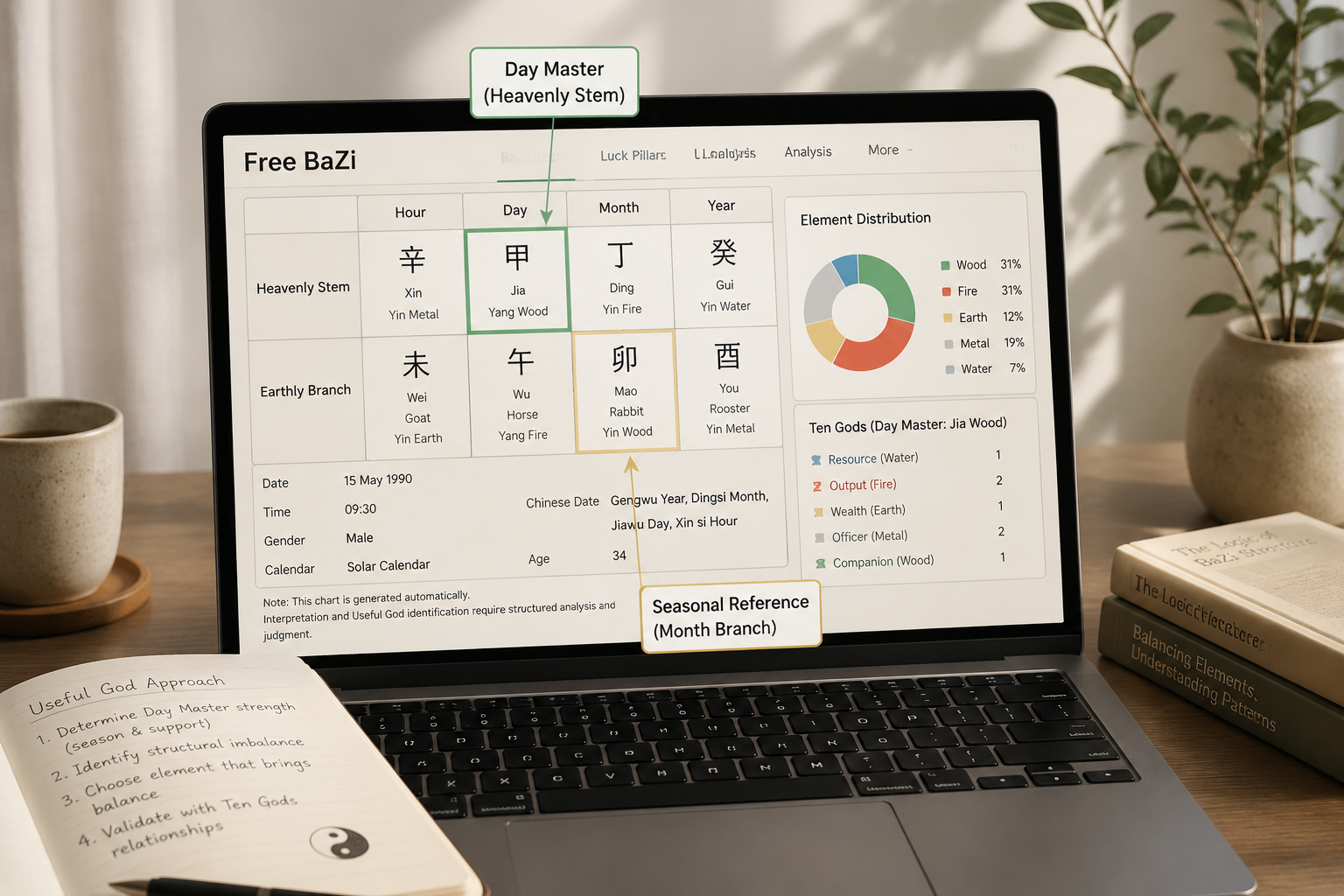
Count visible support, output, wealth, influence, and resource patterns. Ten Gods vocabulary can refine how an element functions (for example, resource versus output), but element balance still comes first for most introductory Useful God paths.
A practical decision path
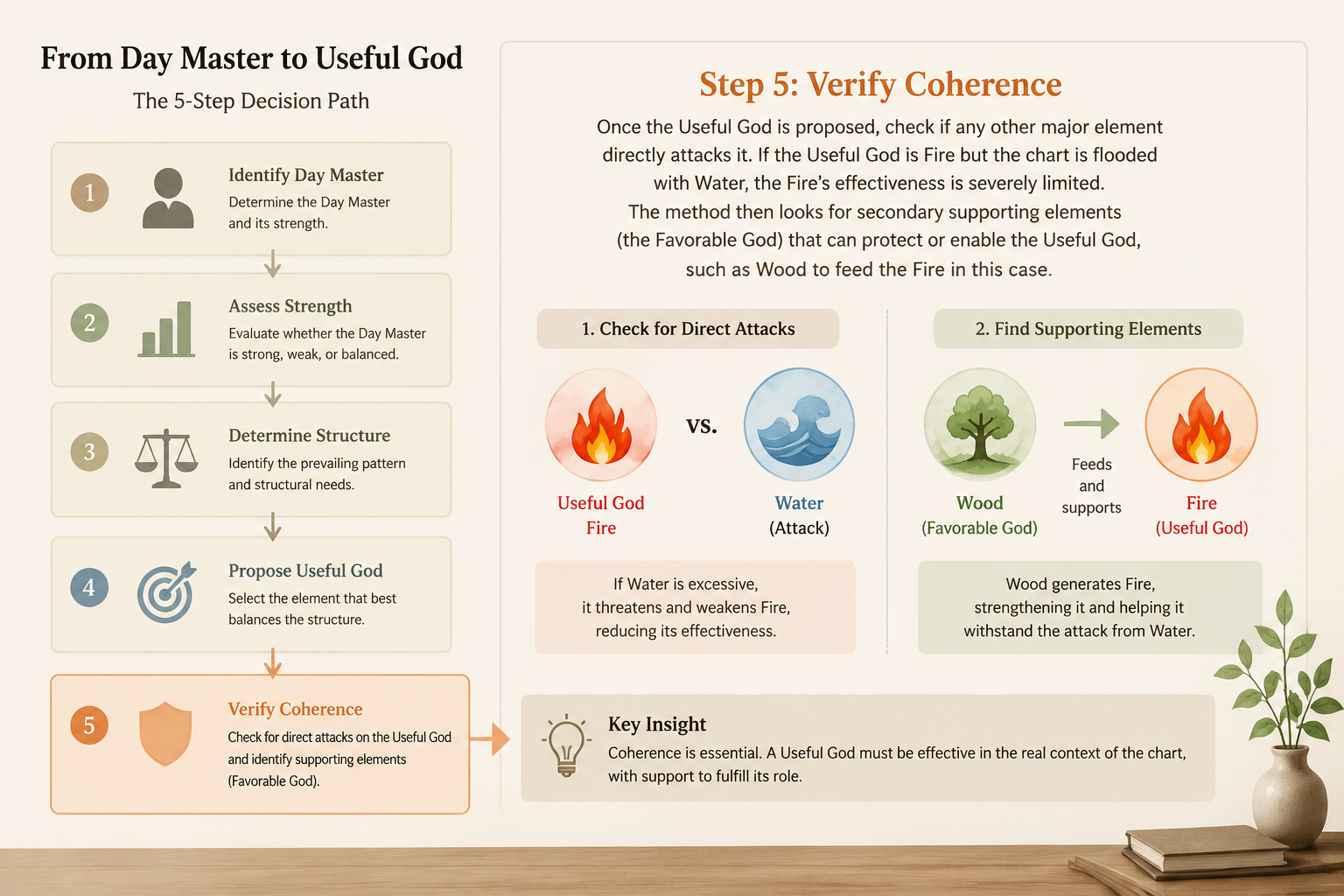
Use the following sequence as a study checklist. It is a reading path, not a verdict engine.
Step 1 — Establish the chart cleanly
Generate the four pillars from a reliable birth time conversion. Confirm timezone and calendar handling before interpretation. Free BaZi’s chart tool is designed for that structural first look.
Step 2 — Assess Day Master condition
Ask comparative questions only:
- Is the Day Master heavily supported by season and peer/resource stems and branches?
- Is it drained by strong output, controlled by strong influence, or isolated?
- Are there obvious extremes (very crowded one element, nearly missing another)?
Avoid binary slogans. “Somewhat supported but seasonally pressed” is more honest than forced labels.
Step 3 — Name the main tension
Examples of tension statements:
- Strong Day Master with little wholesome outlet → may need controlled output or appropriate wealth engagement in symbolic terms.
- Weak Day Master under heavy control → may need resource or peer support as counterbalance language.
- Chart clogged by combinations that stall flow → may need a mediating element that restores circulation.
Step 4 — Select candidate Useful Gods
Candidates are elements or roles that address the tension with the least side damage. A Useful God that “helps” one corner while wrecking the seasonal command is often a poor primary pick.
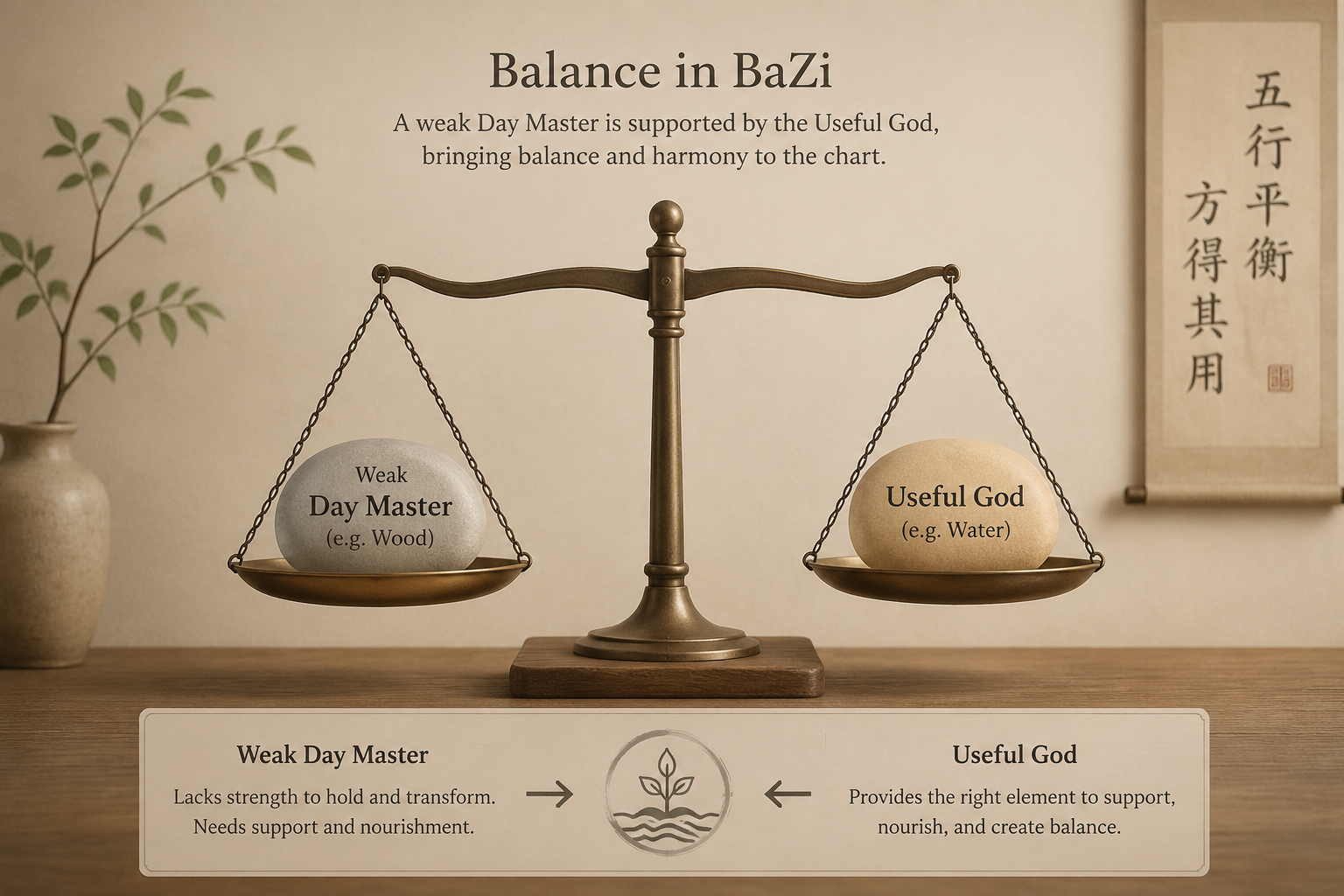
Step 5 — Stress-test with structure, not wishfulness
Check clashes, combines, hidden stems, and whether the candidate actually appears in the chart or only as a theoretical need. A needed element that never shows may still be discussed as a thematic preference in timing layers, but it should be labeled as absent support, not invented presence.
Step 6 — Revisit under luck pillars
When you study luck pillars, ask whether a period supplies, harms, or complicates the working Useful God. This is comparative timeline reading—still non-deterministic.
Common Useful God patterns (illustrative only)
These sketches show how language is used, not rules that always apply.
| Chart tension (simplified) | Often-discussed support direction | Reading caution |
|---|---|---|
| Day Master thin, season hostile | Resource / peer support | Do not ignore strong control that resource cannot reach |
| Day Master very strong, little drain | Output or controlled wealth imagery | Excess “support” can worsen congestion |
| Influence excessive on a fragile DM | Resource to transform influence | Check whether resource is available in stems/branches |
| Flow blocked by tight combines | Mediating element that reopens cycle | Mediation differs by school; keep alternatives |
When two candidates both seem plausible, document both. Transparent disagreement is better than forced certainty.
Useful God, Favorable Element, and related terms
Readers often meet overlapping vocabulary:
- Useful God (用神): the primary balancing function in a given method pass.
- Supporting God (相神): assists the Useful God or protects its mechanism.
- Unfavorable / opposing factors: labels for what aggravates the main tension—still descriptive, not moral.
- Favorable elements: a broader educational shorthand sometimes used in modern primers; less precise than a full Useful God argument.
If a text jumps straight to lucky colors without showing Day Master and month logic, you are no longer in method-first territory.
How to study Useful Gods with Free BaZi tools
- Open the BaZi chart and locate Day Master and month branch first.
- Scan the element distribution panel before Ten Gods detail.
- Write a one-sentence tension statement in plain language.
- Only then propose a Useful God candidate and one runner-up.
- Optionally cross-check day themes on the Huangli route as calendar context—not as proof of a chart conclusion.
- Save your notes with assumptions listed (school bias, uncertain birth time, etc.).
This habit keeps Useful Gods attached to evidence on the page.
Worked mini-example (hypothetical)
Suppose a chart shows a Water Day Master born in a strong summer month, with little Water or Metal visible and abundant Fire and Earth. A method-first tension statement might be: “Season and distribution press the Day Master; resource/support pathways look thin.”
Candidate discussion could include Metal (to feed Water in five-phase terms) and Water peer support, while asking whether Earth is only draining or also acting as a bridge. The “answer” is the quality of the argument—season, counts, and side effects—not a slogan.
Change the month to a wet winter, and the same Day Master may no longer need the same primary help. That sensitivity is why Useful Gods are contingent labels.
Frequent mistakes
- Skipping season. Favoring a textbook element list while ignoring the month branch.
- Over-trusting nicknames. Memorizing “this DM always likes X” collapses chart diversity.
- Single-factor obsession. One Useful God label cannot carry career, health metaphors, and timing alone.
- Retrofitting. Choosing a flattering element first, then forcing the strength story to match.
- Importing absolute timing claims. Luck pillars modulate availability; they do not convert BaZi into certainty.
FAQ
What are Useful Gods in BaZi?
Useful Gods are method labels for the element or role that best addresses a chart’s main imbalance relative to the Day Master and structure. They are interpretive tools inside a cultural reference system, not independent spirits and not guaranteed predictors.
How do I find the Useful God in my chart?
Build the four pillars, assess Day Master condition against the month branch and elemental distribution, state the main tension, then test which support reduces that tension with the fewest structural conflicts. Use a clear BaZi chart view and keep alternate candidates when evidence is mixed.
Are Useful Gods the same as favorable five elements?
Not exactly. Favorable-element lists are often simplified teaching shortcuts. A Useful God claim should show a balance argument—strength, season, flow, and side effects—sometimes including Ten Gods nuance beyond a single color or element preference.
Can the Useful God change over time?
Your birth pillars are fixed as a natal map, but luck pillars and annual layers change which supports are emphasized or challenged. Readers often revise which function is most “in play” for a period while still anchoring to the natal tension.
Should I use Useful Gods for daily decisions?
For day-to-day calendar context, browse Huangli as a separate traditional reference. Useful God analysis is heavier chart work; it is better suited to structured study than to constant micro-decisions.
Summary
Useful Gods in BaZi are balance hypotheses tied to the Day Master, season, and chart structure. Read them slowly: evidence first, label second, limits always visible. When you want the structural view without mystique, start with the open BaZi chart tool and keep your Useful God notes attached to what the pillars actually show.