2027 Ding Wei Year Outlook: Read the Fire Goat Year the BaZi Way
A grounded BaZi reading of the 2027 Ding Wei (Fire Goat) year. Learn what Ding and Wei mean, how the year interacts with your Day Master, and where the method stops short of prediction.
In the Chinese sexagenary cycle, each year is carried by one Heavenly Stem and one Earthly Branch. The year 2027 is 丁未 (Ding Wei): the Yin Fire Stem paired with the Yin Earth Branch, commonly translated as the Year of the Fire Goat or Fire Sheep. For BaZi readers, this pair is not a motto; it is a structured signal that can be read through Five Element logic, Ten God roles, and branch relationships. This guide shows what the combination means, how to test it against your own chart, and where the reading stops.
What Kind of Year Is 2027 in the Ganzhi Calendar?
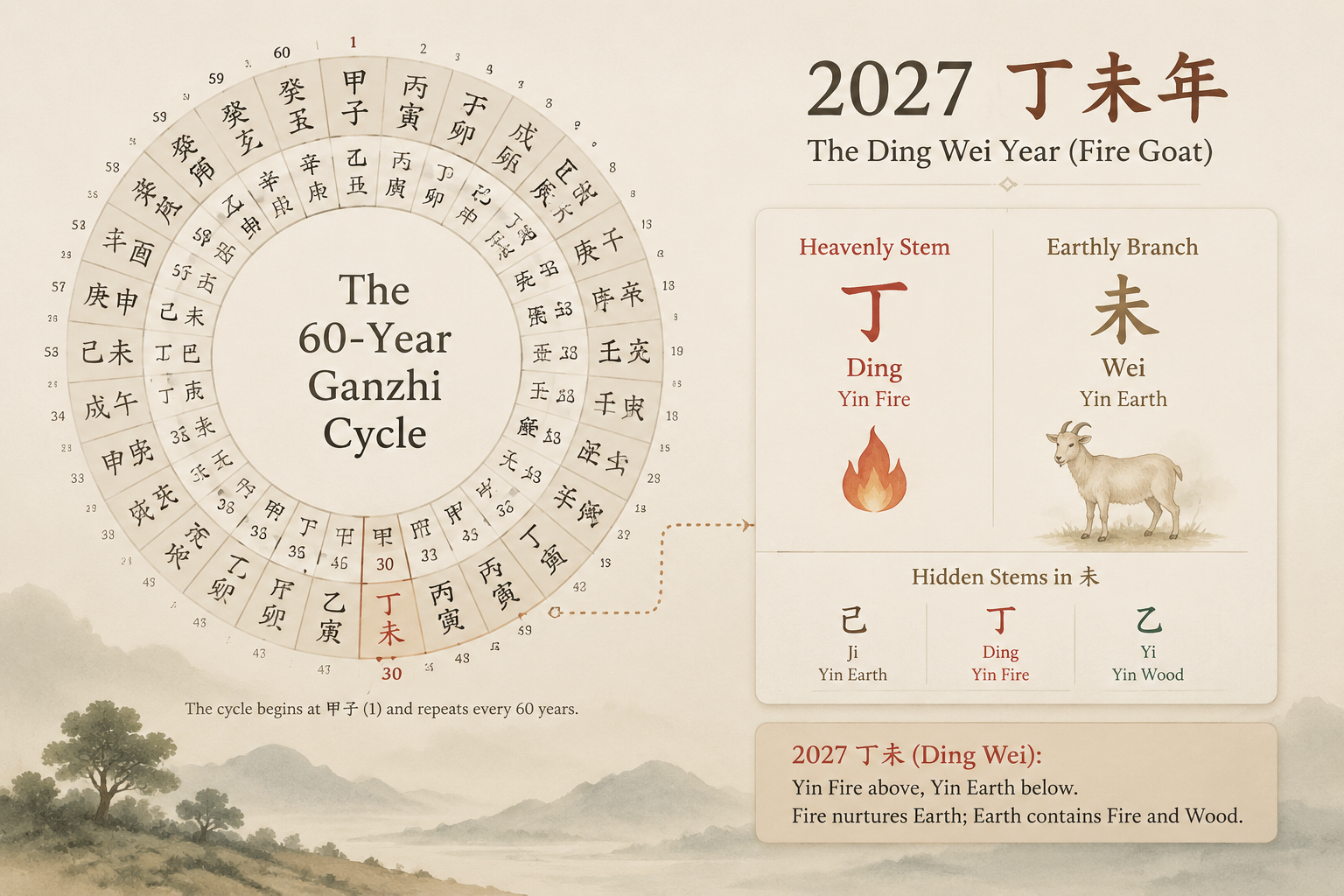
The sexagenary cycle is a repeating list of sixty stem–branch pairs. It begins with 甲子 (Jia Zi) and advances one step each year. In that sequence, 2027 is the forty-fourth pair, 丁未. Because the branch 未 is the Goat (or Sheep) and the stem 丁 is Fire, many popular calendars call 2027 the Year of the Fire Goat.
There is a boundary date to know before using any BaZi tool. In the modern BaZi convention, a year begins at 立春 (Li Chun, the Start of Spring), which falls around February 4, 2027. Lunar New Year in 2027 falls on February 6. The Free BaZi chart tool places your pillars using solar terms, not the lunar calendar. If you were born in late January or early February, your zodiac-sign year and your BaZi year may belong to different pillars—this is normal and worth checking.
Ding Wei is a particular pair. 丁 is yin fire—lamp light, a candle, a small but persistent flame. 未 is yin earth—a harvested field, a garden, late-summer soil. Together they describe a year in which warmth turns into tangible growth.
Ding and Wei: The Elements Behind the Year
The direct way to understand 2027 is through the Five Element behavior of its two characters.
Ding is Yin Fire. In BaZi imagery, yang fire is the sun; yin fire is the light that depends on fuel. It appears as candlelight, a cooking fire, or the ember that carries heat through the night. Ding is associated with careful insight, expression, culture, and close-up warmth. It is also easily exhausted when it gives too much.
Wei is Yin Earth. It sits in the eighth position of the twelve Earthly Branches and belongs to the late-summer season. Its main qi is 己 (Yin Earth), which gives Wei a receptive, nourishing nature. But Wei contains two hidden stems as well: 丁 (Yin Fire) and 乙 (Yin Wood). The ground of 2027 is therefore not empty. Inside it, the year's flame is already rooted, and a sliver of wood—the fuel that feeds fire—is stored below the surface.
Read as a chain, the energy moves from hidden 乙 Wood to 丁 Fire, then from 丁 Fire to 己 Earth. In plain terms, 2027 is a year in which ideas want to become material. Fire spends itself to grow the ground, so the year rewards creating, caring, and harvesting—but it also asks you to watch your fuel supply. Burnout is a very Ding–Wei theme, not because the stars decree it, but because the structure shows fire being spent.
Wei is also one of the four "storage" branches (辰戌丑未), specifically the storehouse of Wood. This brings completion and harvest into the reading: cycles that began years ago may reach a natural ending, and the seed for the next cycle is already waiting inside the same soil.
How to Read This Year in Your Own Chart
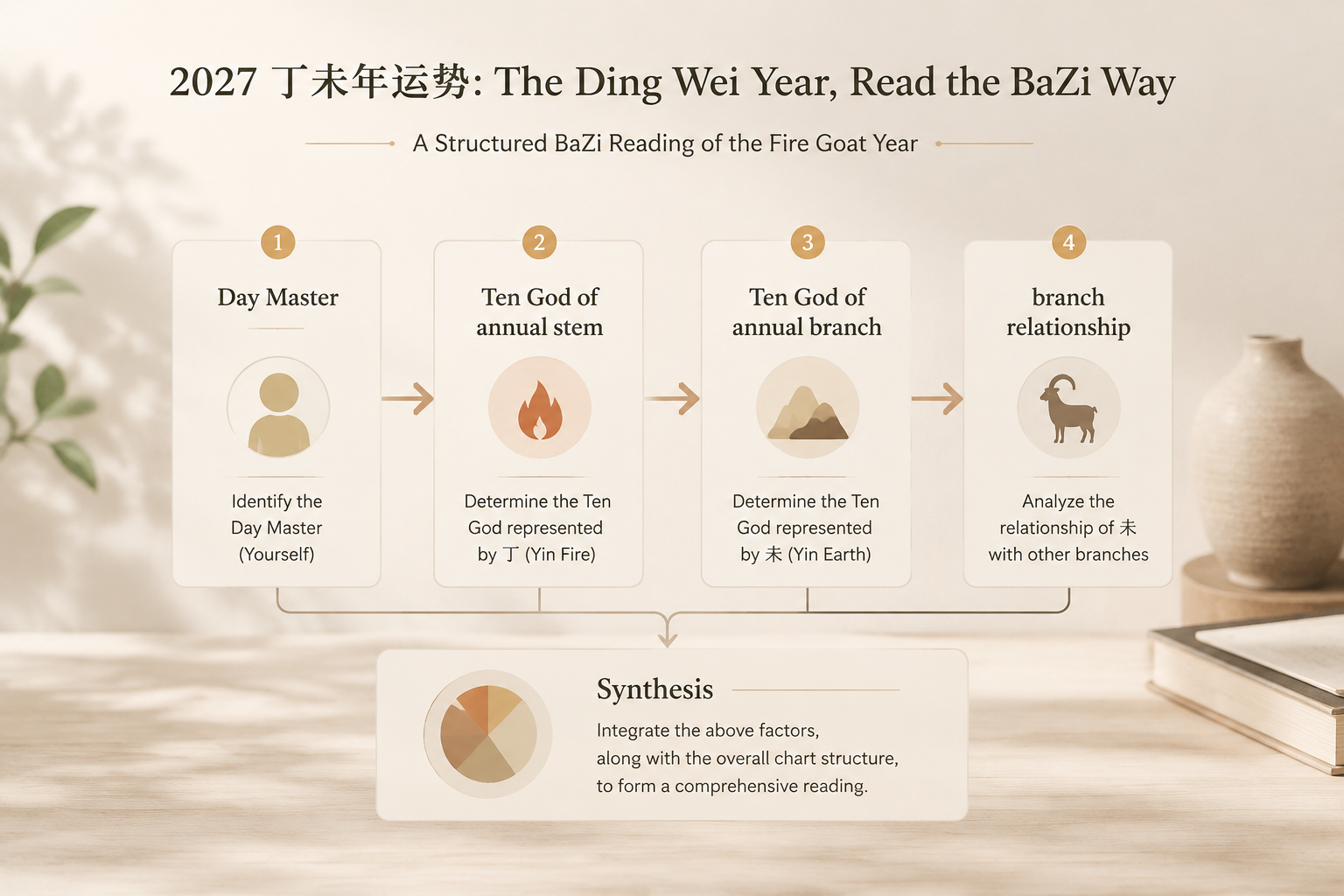
An annual BaZi reading becomes specific when you set the 2027 pillar beside your natal pillars. Four steps are enough to begin.
Step 1: Find your Day Master. The Day Master is the Heavenly Stem of your day pillar. It represents you in the reading. If you have not generated a chart yet, create your BaZi chart for free, and the tool will display the ten stems and twelve branches of your birth moment.
Step 2: Map the annual stem as a Ten God. Place 丁 in front of your Day Master and read the relationship through the Ten Gods. These are role labels, not deities: they describe how the year's energy treats you. For a 庚 Metal Day Master, Ding is Direct Officer, the role associated with structure and responsibility.
Step 3: Map the annual branch. The main qi of 未 is 己 Earth, so the branch can be mapped through the same Ten God rules. The stem is the foreground of the year; the branch is the background.
Step 4: Check branch relationships. 未 can combine with, clash with, or harm a branch in your natal chart. This is the personal timing layer. The relevant patterns for 2027 are described below.
Ten Gods at a Glance: Ding and Wei by Day Master
The table below shows the Ten God reading for each Day Master when it meets the stem and branch of 2027.
| Day Master | Stem 丁 (Yin Fire) | Branch 未 (Yin Earth) |
|---|---|---|
| 甲 Yang Wood | 伤官 Hurting Officer | 正财 Direct Wealth |
| 乙 Yin Wood | 食神 Eating God | 偏财 Indirect Wealth |
| 丙 Yang Fire | 劫财 Rob Wealth | 伤官 Hurting Officer |
| 丁 Yin Fire | 比肩 Companion | 食神 Eating God |
| 戊 Yang Earth | 正印 Direct Resource | 劫财 Rob Wealth |
| 己 Yin Earth | 偏印 Indirect Resource | 比肩 Companion |
| 庚 Yang Metal | 正官 Direct Officer | 正印 Direct Resource |
| 辛 Yin Metal | 七杀 Seven Killings | 偏印 Indirect Resource |
| 壬 Yang Water | 正财 Direct Wealth | 正官 Direct Officer |
| 癸 Yin Water | 偏财 Indirect Wealth | 七杀 Seven Killings |
Use the table as a reading aid, not a verdict. Three examples show the range.
A 丁 Fire Day Master meets Ding as Companion and the branch 未 as Eating God. The method can point to visible peer activity, creative output, and caregiving. Because fire generates earth, the same reading reminds a Ding person to stop before their own flame is drained.
A 庚 Metal Day Master sees Ding as Direct Officer and 未 as Direct Resource. Classically, this reads as "responsibility on a supporting cushion": duties are present, but resources and counsel are available. Work and family life may feel more clearly structured.
A 癸 Water Day Master sees Ding as Indirect Wealth and 未 as Seven Killings. That is a more demanding pairing. Wealth can appear as opportunity or pressure, and Seven Killings can make the year feel urgent. If your Day Master is 癸, the practical advice is to approach risk slowly, verify details, and avoid decisions made from fatigue or fear. None of this is predetermined.
Structure and Timing: What Wei Meets in Your Chart
The Wei branch forms several structural relationships with natal branches in 2027.
- 午未六合 (Six Harmony). If 午 is in your chart, the annual branch combines with it. This is usually read as a stabilizing or binding influence around the life area that 午 represents.
- 亥卯未三合木局 (Three Harmony Wood Bureau). If you have 亥 or 卯, the arrival of 未 can move the chart toward a complete Wood structure. Wood feeds the Fire of the stem, so this pattern can energize growth and creativity.
- 丑未冲 (Clash). If 丑 is in your chart, the annual branch clashes with it. In this method a clash means activation: movement, shifting schedules, new positions. It is not good or bad on its own; it simply says that something in that life area will move.
- 子未害 (Harm) and 未戌刑 (Punishment). 子 with 未 creates subtle friction and misunderstanding; 未 with 戌 creates self-imposed pressure and small repeated disputes. Both are lower-key than a clash, but they reward extra clarity and patience.
The pillar that holds the interacting branch gives the reading a location: the year pillar can point to family and early life, the month pillar to career and routine, the day pillar to partnership and the self, and the hour pillar to children or later life.
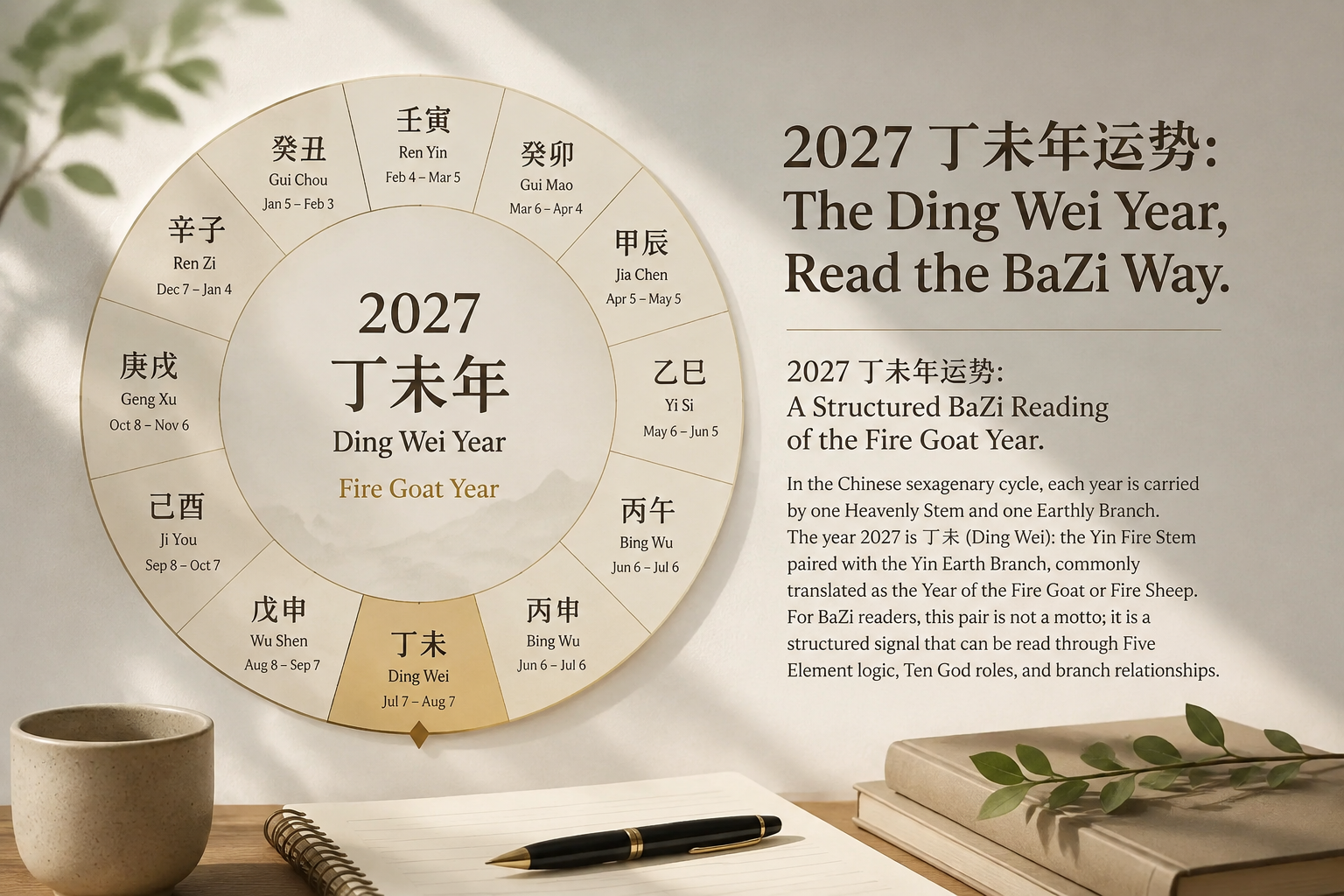
One date is worth circling. From around July 7 to August 7, 2027, the month pillar is also 丁未. A month that mirrors the year concentrates the year's theme; it is a useful window for observing and working with the energy of 2027.
Years Are Only One Layer: Months, Days, and Huangli
The annual pillar is the broadest stroke in a BaZi reading. Each solar month of 2027 has its own pillar—the month after Li Chun is 壬寅, and the sequence closes with 癸丑 in early 2028. The solar-month structure is what BaZi and Huangli tools use to refine timing.
For day-level decisions, the Huangli (黄历) is the traditional layer. It labels each day with its own pillar, marks solar terms, and lists the day's suitable and less suitable activities. The year tells you which weather system you live in; the Huangli describes how a particular walk may feel. You can consult today's Huangli before planning a trip, meeting, or family event—as a cultural reference aid, not a command.
What a Ding Wei Reading Can and Cannot Do
Let the boundary be clear. A BaZi annual reading is a structured method of cultural interpretation and self-reflection. It is not a scientific prediction and not a guarantee of any outcome. The annual pillar is only one layer: natal pillars, Luck Cycles (大运), monthly pillars, and your own choices all shape how the year unfolds. Two people with the same Day Master can experience 2027 differently because their charts are different.
Read in that spirit, the Ding Wei year offers a useful lens. It asks whether you are spending your energy well, whether your warmth is reaching the people and projects around you, and whether you are saving fuel for the seasons ahead. If a reading makes you pause, treat it as an invitation to look closer—not as a sentence.
FAQ
When does 2027 丁未年 begin for BaZi purposes?
For BaZi and Huangli calculations, the Ding Wei year begins at 立春 (Li Chun), around February 4, 2027. Lunar New Year follows on February 6. Free BaZi tools use the Li Chun boundary.
Does the Fire Goat year affect my zodiac sign?
The zodiac Goat is the branch 未, but a BaZi reading does not focus on your birth-year animal alone. Your Day Master and all four pillars determine how the year appears to you. The zodiac sign is one small layer of the full chart.
My chart contains 丑. Does the 丑未 clash mean I will have a bad year?
A clash is an activation, not a curse. It usually describes movement or change in the life area connected to 丑: a new role, a relocation, or the end of an outdated arrangement. The outcome depends on the rest of your chart and your decisions, so read it as a signal to plan with awareness.
How accurate are annual BaZi readings?
Accuracy in BaZi depends on interpretive depth, not deterministic certainty. An annual reading is most useful when it is drawn from your full chart and used as a reflective framework. It describes tendencies in the method's own logic; it does not reveal fixed events.
Next Steps
- Generate your chart: Free BaZi chart tool
- Check solar terms and daily pillars: Huangli calendar
- Keep the reading light and compare it with your own experience. The chart is a mirror, not a map of fate.
Related reading
Related guide
Ding Chou Day Pillar: The Hidden Spark in Your Chart
Learn how the Ding Chou day pillar works in a BaZi chart: Ding Fire on Chou Earth, hidden stems, Ten Gods, reading steps, and honest limits.
Related guide
2027 Ten Heavenly Stems Forecast: Reading the Ding Wei Year in BaZi
Explore the 2027 ten Heavenly Stems forecast through BaZi. Learn how the Ding Wei year maps onto each Day Master, with clear reading paths and limits.
Related guide
What Is a BaZi Chart? A Beginner's Guide to the Four Pillars
Learn what a BaZi chart is, how the Four Pillars work, what the Day Master means, and how to read your chart with a clear, methodology-based approach.