2027 Feng Shui Forecast: Fire Goat Year and How to Read It
Understand the 2027 feng shui forecast as a cultural and structured reading method. Learn about the Fire Goat year, annual directions, BaZi, and Huangli.
The 2027 feng shui forecast begins with a simple calendar fact: the Chinese year is a Ding Wei year, also known as the Fire Goat year. Feng shui forecast articles usually pair that fact with a list of annual directions, dates, and advice. This article takes a different path. It explains how a feng shui forecast is constructed, what the Fire Goat label actually describes, and how you can use a BaZi chart and the Huangli almanac to build your own grounded annual reading.
What a Feng Shui Forecast Is and Is Not
A feng shui forecast is a seasonal, place-based reading. It uses the Chinese calendar to describe the atmosphere of a year and the directions that traditional schools consider worth special attention. The word “forecast” can make it sound like a weather report for your life. A more careful description is that it is a structured cultural map: it helps you decide where to put your attention in your home, when to schedule changes, and what to leave alone.
The method has real limitations. It does not predict whether someone will get a job, meet a partner, or fall ill. It also cannot override practical concerns like building safety, budget, or medical care. When you read a 2027 feng shui forecast, treat it as one layer of context, not as a final judgement.
Why 2027 Is Called the Fire Goat Year
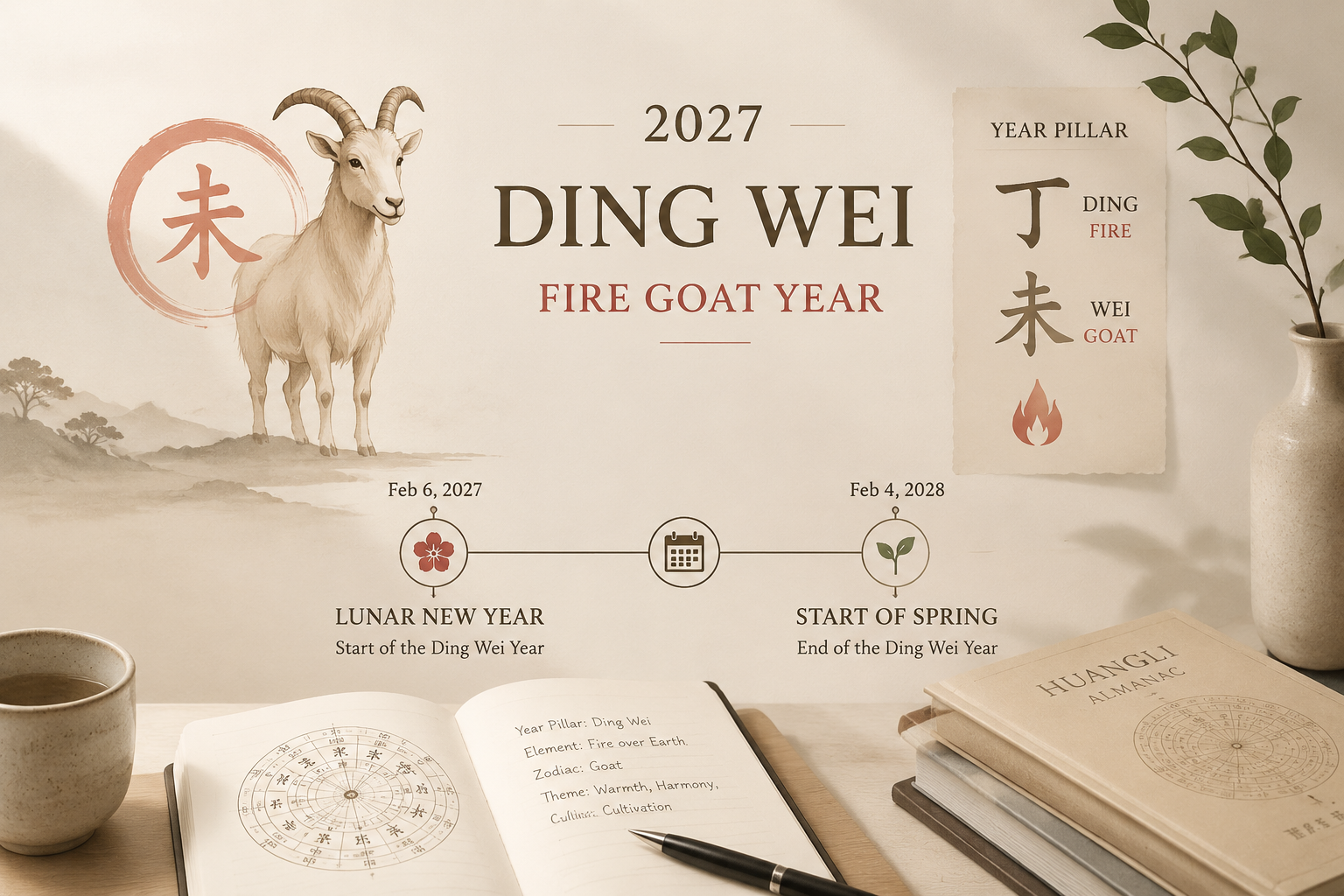
Every Chinese year is named by two characters: a heavenly stem and an earthly branch. In 2027 the stem is Ding and the branch is Wei. Ding is a yin Fire energy, and Wei is the Goat or Sheep branch, which belongs to Earth. Combined, they create the shorthand “Fire Goat” or “Fire Sheep.” The phrase “Fire Goat 2027” appears in many lunar new year guides. It is not a description of your birth animal; it is the name of the year pillar.
In BaZi, this pair becomes the year pillar of the 2027 chart. The year pillar describes the general climate of the year, but it is not the whole chart. A complete BaZi reading includes the year, month, day, and hour pillars, along with the ten gods and luck cycles. For that reason, a personal 2027 BaZi forecast is always more detailed than an annual zodiac or feng shui overview.
Here is an example of the difference. If your Day Master is Metal, a Fire year may appear as a pressure to refine, restructure, or let go of old forms. If your Day Master is weak Water, Fire can be a stress factor. But the same Fire visit may be useful in a chart that needs warmth or movement. The year pillar does not work alone.
Calendar Mechanics: One Year, Two Starting Lines
A common point of confusion in annual forecasts is the start date. Most lunar calendars celebrate the new year on the second new moon after the winter solstice. In 2027, Chinese New Year falls on 6 February. BaZi, however, changes the year pillar at Li Chun, or Start of Spring, which usually falls around 4 February.
That small gap matters. If someone is born in the first days of February 2027, the two calendars may assign different annual animals. That is a convention difference, not a contradiction. When you use the Free BaZi Huangli calendar, you can see the exact solar terms and lunar dates for the year, so your comparison stays consistent.
How Annual Feng Shui Directions Are Constructed
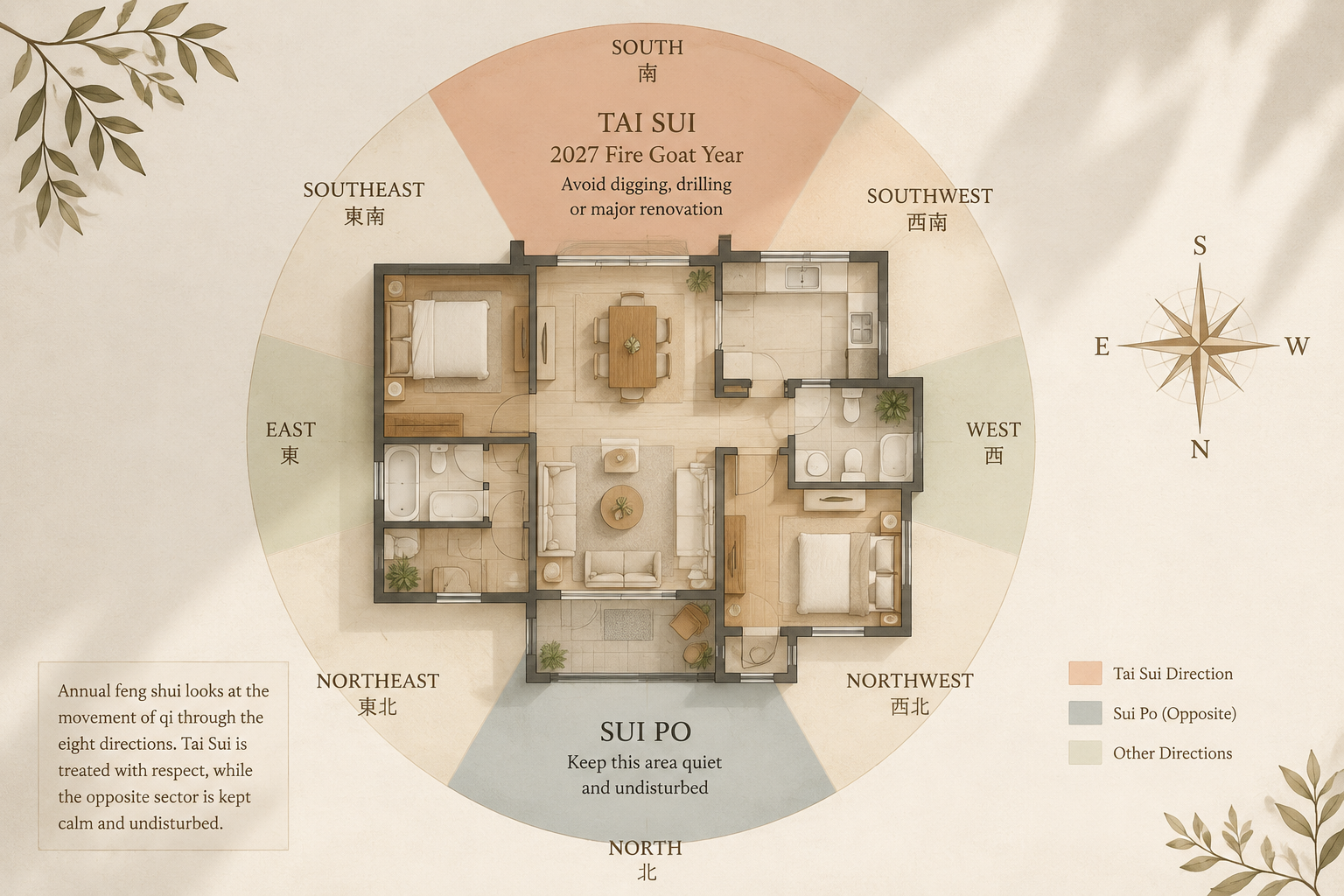
Annual feng shui forecasts often focus on directions rather than personality. The year branch places several points of focus in a house: Tai Sui is the “grand duke” of the year, Sui Po faces opposite it, and various flying stars move through the eight compass sectors. For a Goat year, many schools place Tai Sui in the south-southwest or southwest area of the house, and Sui Po in the opposite sector. The exact compass line depends on the tradition and the type of feng shui system used.
The traditional advice is usually restrained. If Tai Sui is in a particular direction, avoid digging, drilling, or starting a large renovation there during the year. If the opposite sector is mentioned, keep it quiet and free of clutter. Some guides also note the annual “five yellow” star and suggest no heavy banging in that corner.
Notice what this method actually does. It gives you a small set of spatial reminders for a twelve-month cycle. It does not say that the rest of the house is cursed or that you must buy any object to “fix” anything. A good annual feng shui reading simply asks you to move through your home with more attention.
How to Use BaZi and Huangli for a Personal Annual Review
A generic 2027 feng shui forecast can be a useful starting point, but a personal review is more grounded. You can do this in four steps:
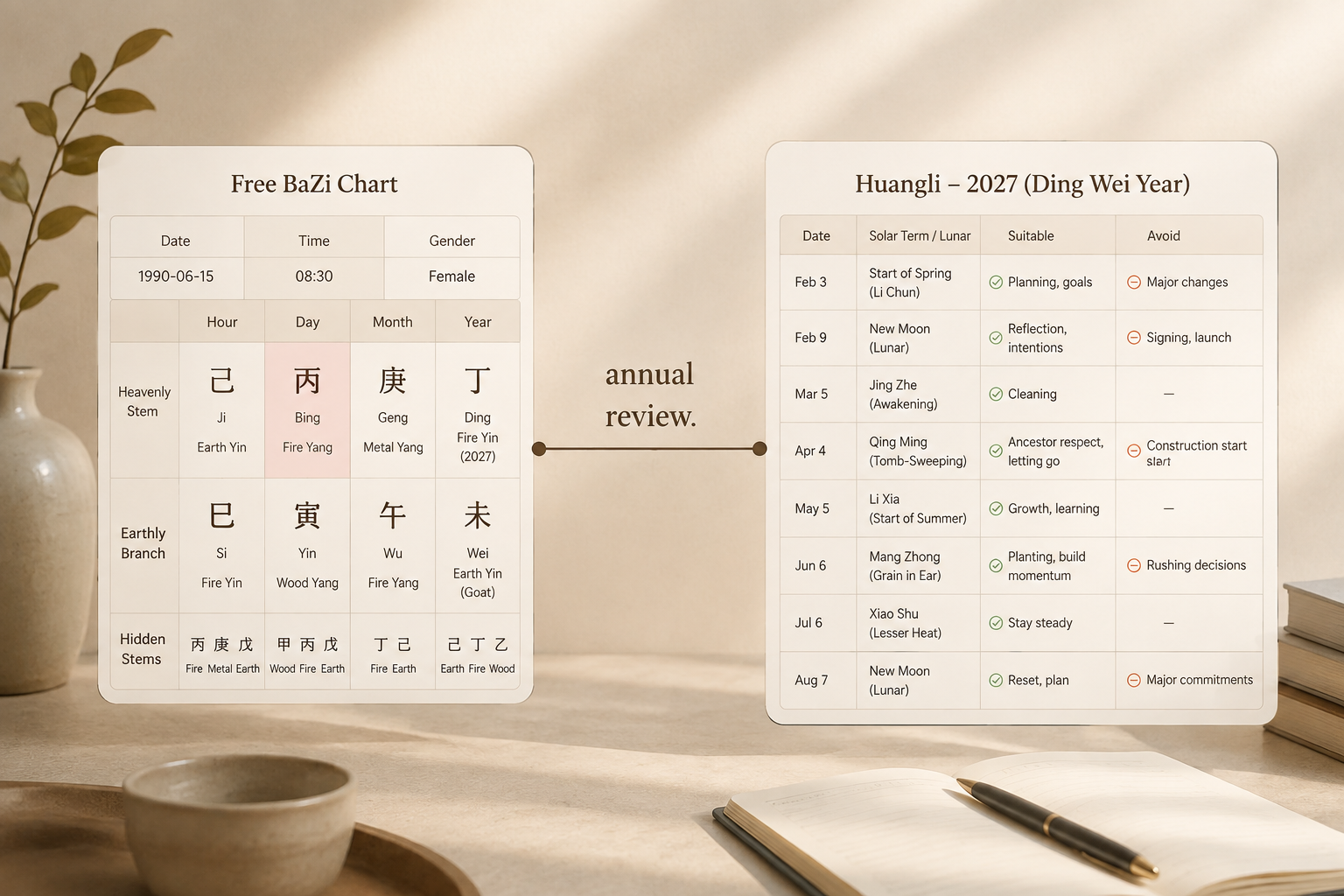
- Generate your BaZi chart. Use the free BaZi chart tool to find your Day Master, your current luck pillar, and the year pillar for 2027. You are looking for patterns, not omens.
- Check the Huangli for key dates. Open the Huangli calendar and note the solar term dates, lunar new moon dates, and any days the almanac marks for cleaning, starting construction, or avoiding major changes. Use these as a planning layer, not a moral scoreboard.
- Translate the year pillar into your own element climate. If your chart already has a lot of Fire, a Ding Wei year may amplify that theme. If your chart needs Fire, the same year may feel more supportive. The exact effect depends on your Day Master and its relationship with the annual stem.
- Choose one or two spatial actions. Instead of trying to follow every annual direction, pick one room you use daily. If the 2027 feng shui source you trust names a direction in that room, keep that area uncluttered and avoid unnecessary construction there. Then move on with your normal life.
A Calm Household Practice for 2027
Feng shui does not have to be a dramatic event. For the Fire Goat year, a restrained annual practice might look like this:
- Do a slow spring clean in February, after Chinese New Year.
- Remove anything broken from your entrance and the room where you spend the most time.
- If you are planning renovations, check the Huangli for a date that is not marked as conflicting with the year’s directions.
- Keep a small log of the themes that show up in your home and work life. By the end of the year, it becomes a record of how the year’s climate interacted with your personal rhythms.
This practice is cultural and reflective. It does not require special objects, payments, or promises. It also works whether you are a regular feng shui reader or a newcomer who simply wants a structured way to clean, plan, and think.
FAQ
Is the 2027 feng shui forecast scientific?
The forecast is a cultural and symbolic method. It can help you plan your environment and reflect on your year, but it is not a scientific prediction. Treat it as a reference layer alongside practical decision-making.
What is a Fire Goat year?
Fire Goat is the common name for the Ding Wei year in the Chinese calendar. Ding is yin Fire, and Wei is the Goat branch. In BaZi, this pair is the year pillar for 2027.
Which direction should I avoid in 2027?
Most annual guides place Tai Sui in the south-southwest or southwest in a Goat year, so they suggest avoiding digging or major construction in that sector. The exact direction varies by school. If you are unsure, choose the broader direction sector and keep it orderly, but do not let a forecast turn into anxiety.
What is the difference between a feng shui forecast and a BaZi forecast?
A feng shui forecast is place-based and uses annual directions, flying stars, and the Huangli. A BaZi forecast is time-based and uses the four pillars of a person’s birth chart, especially the Day Master and the year pillar. The two can be combined, but they are not the same system.
Use the Annual Calendar as a Starting Point
A 2027 feng shui forecast is most useful when it stays in its own lane: a cultural frame for attention, planning, and reflection. If you want to see how the Fire Goat year interacts with your own chart, generate a free BaZi chart and then check the Huangli calendar for dates and solar terms. You will get a far more personal reading than any one-size-fits-all forecast.
Related reading
Related guide
2027 Chinese Zodiac: Year of the Fire Goat in BaZi Reading
A clear guide to the 2027 Chinese zodiac, the Year of the Fire Goat (Ding Wei), and how a BaZi chart reading treats this annual pillar with more depth than a simple animal sign.
Related guide
2027 Zodiac Forecast: A Structured Guide to the Year of the Fire Goat
Learn what the 2027 zodiac forecast actually measures, how the Ding Wei year pillar interacts with your chart, and how to read the Year of the Goat without mystical claims.
Related guide
2027 Ding Wei Year Outlook: Read the Fire Goat Year the BaZi Way
A grounded BaZi reading of the 2027 Ding Wei (Fire Goat) year. Learn what Ding and Wei mean, how the year interacts with your Day Master, and where the method stops short of prediction.