2027 Goat Year Outlook: How to Read the Year of the Fire Goat with BaZi
A restrained, method-driven guide to reading the 2027 Goat Year (Ding Wei, Fire Goat) through BaZi and Huangli. Learn the reading path, context, and limits.
"2027 羊年运势" is a phrase you will see in calendar apps, zodiac columns, and BaZi discussions. In Chinese culture, it usually means "the outlook for the Goat year." But for anyone who wants a clearer, more structured reading, the question is not simply "will Goat year be lucky or unlucky?" A more useful question is: "How can I read the 2027 Goat year through BaZi and Huangli without turning it into a prediction script?"
This article walks through the cultural logic of the 2027 Goat year, what the Ding Wei year pillar means, and how to use a BaZi chart and Huangli calendar as a structured reading path. It does not provide a guaranteed prediction. Instead, it gives you a method.
What Is "2027 羊年运势" in a BaZi Context?
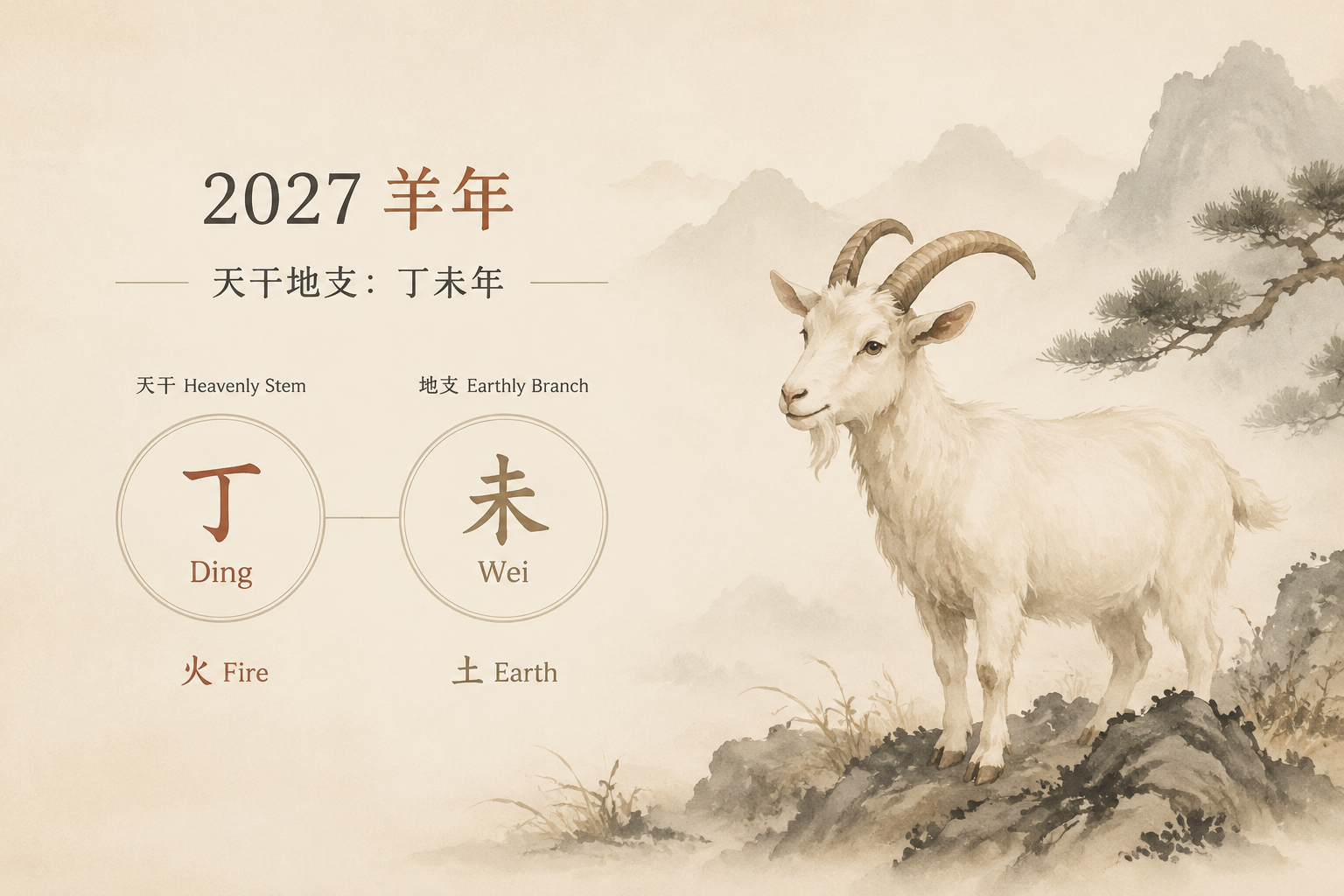
In the Chinese zodiac, 2027 is the Goat year. The English word "Goat" is a translation of 羊, which can also be rendered as Sheep or Ram. The zodiac animal is the public face of the year. In BaZi, however, the year is defined more precisely by a two-character pillar: the heavenly stem and the earthly branch. The year pillar for 2027 is 丁未 (Ding Wei).
Ding is a yin Fire stem. Wei is a yin Earth branch, and it is the branch associated with Goat. Together, Ding Wei is often described as the Fire Goat year. This is not an invitation to reduce the entire year to an animal personality. The pillar gives us a structural point of reference.
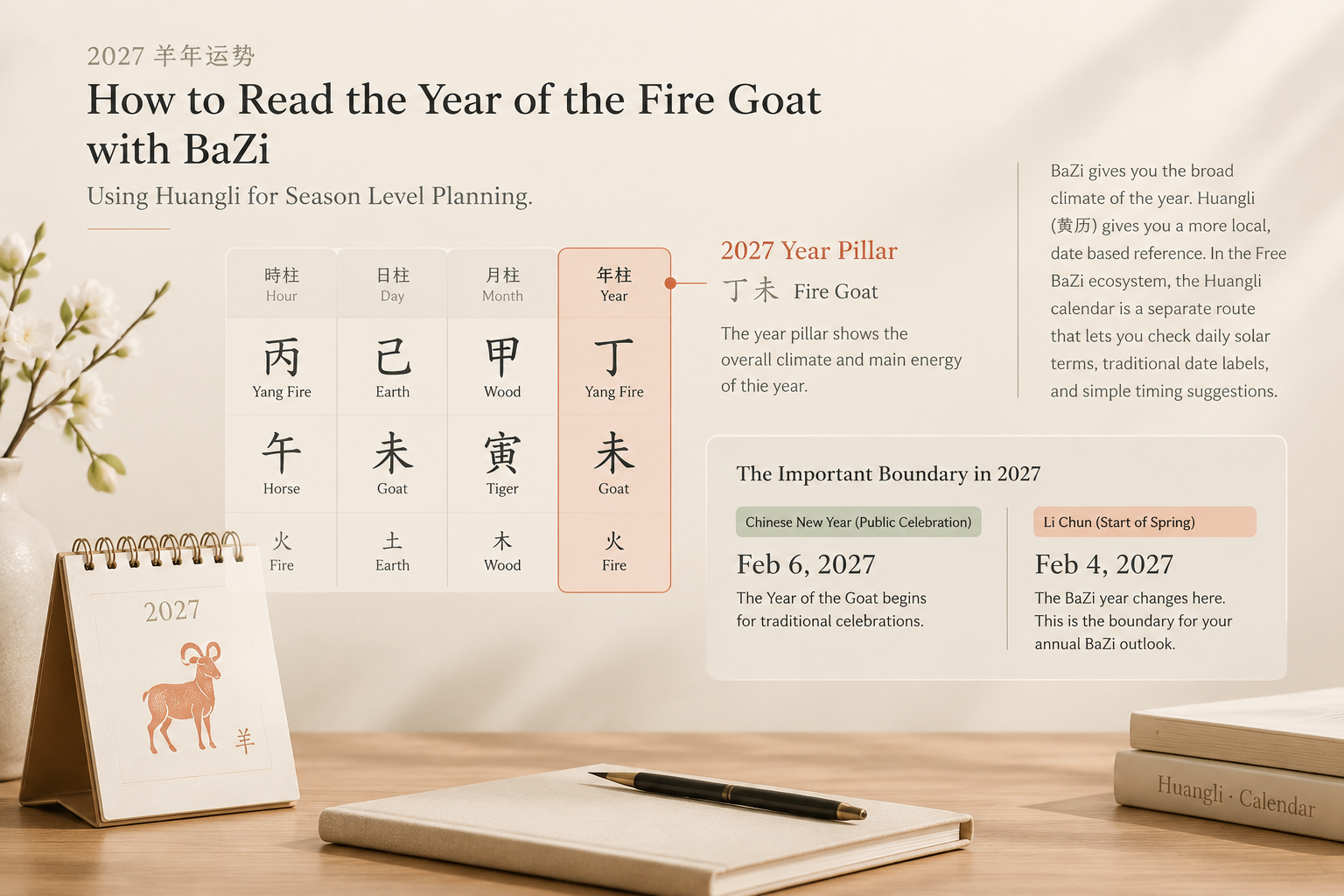
If you already have a BaZi chart from Free BaZi, you can locate the year pillar as one of four pillars. The other three are the month, day, and hour pillars. The year pillar represents the external climate of the year. It is the background weather, not the whole story of your life.
The phrase "羊年运势" often invites a simple "your annual outlook in the Goat year" reading. In BaZi, a more careful phrase is "the annual reading path for the Ding Wei year." That path depends on your Day Master, your current Luck Pillar, and the Huangli timing around your choices.
The 2027 Year Pillar: Ding Wei, the Fire Goat
The year 2027 is the recurrence of a Ding Wei year. In the sixty-year cycle, the previous Ding Wei year was 1967. The next one will be 2087. Cultural tradition notices these cycles, but BaZi does not treat a cycle as a fixed rerun. It treats each occurrence as a set of conditions that interact with a different chart, time, and environment.
The stem Ding is yin Fire. It is often described as the light of a lamp, a quiet candle, or a stable, moderate flame. The branch Wei is Earth, and it contains a mixture of hidden stems: Ji Earth, Ding Fire, and Yi Wood. In practical terms, the Ding Wei pillar suggests fire rooted in earth, with wood feeding the fire underneath the surface. It is less dramatic than the 2026 pillar, Bing Wu (Yang Fire Horse), which is a blazing, obvious fire year. Ding Wei is more diffuse, earthy, and gradual.
This does not mean 2026 is "bad" and 2027 is "good." It means the texture of the environment shifts. A BaZi reading looks at how that texture meets your own Day Master.
Reading note: The year pillar is a climate, not a command. A hot year can feel supportive for some charts and oppressive for others. The same is true for a Fire Goat year.
How to Read Your Own Goat Year Outlook
A grounded BaZi reading of 2027 follows a path. You can use the Free BaZi chart tool to generate your chart, then walk through these steps.
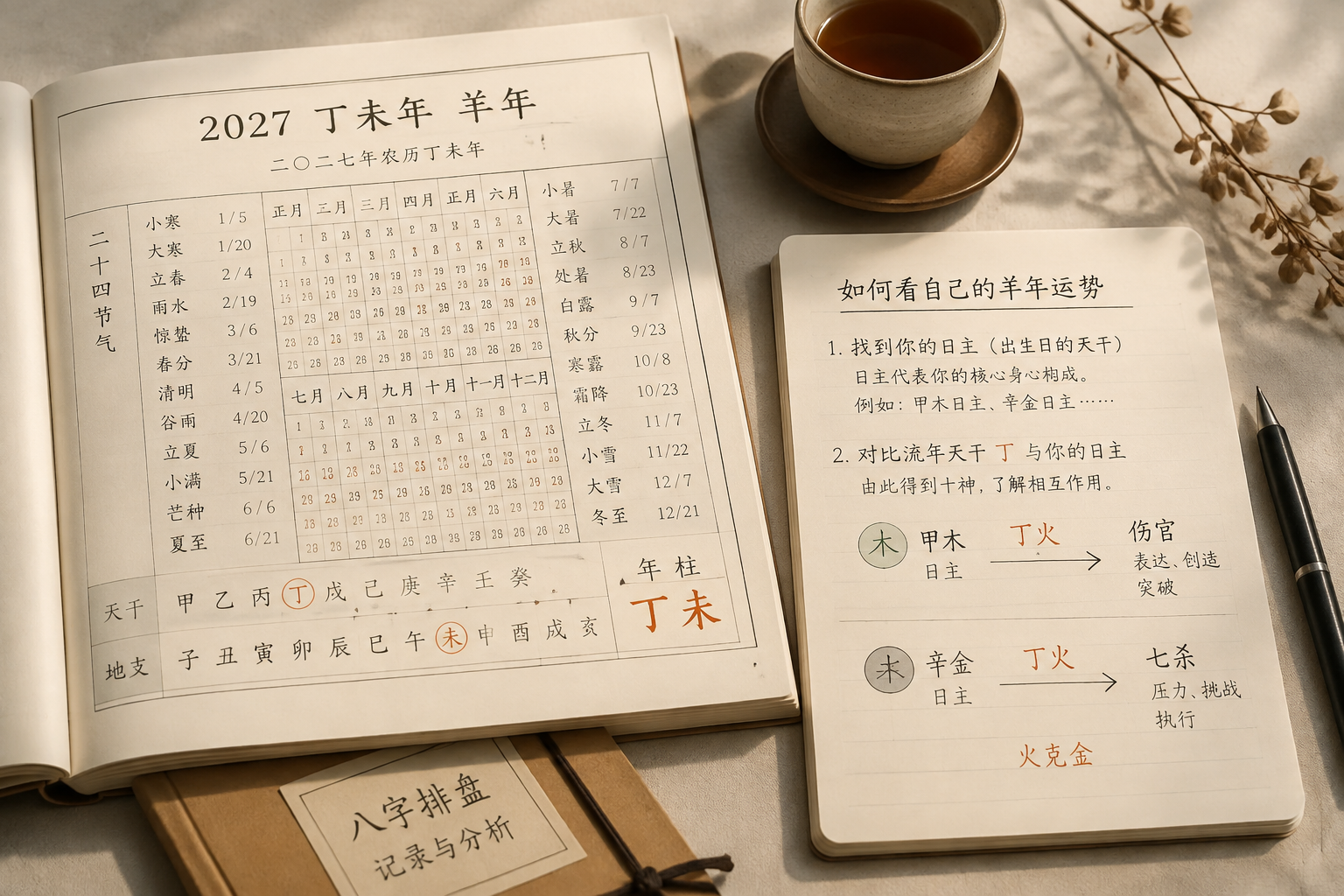
- Find your Day Master. Your Day Master is the heavenly stem of your day pillar. It represents your core physical and emotional constitution. For example, if your Day Master is Jia Wood or Xin Metal, your relationship with Ding Fire will be different.
- Compare the annual stem, Ding, to your Day Master. In BaZi, this comparison produces a Ten God. For a Yang Wood Day Master (Jia), Ding is the Hurting Officer. For a Yin Metal Day Master (Xin), Ding is the Seven Killing. The label matters less than what it tells you about the interaction: Fire controls Metal, while Fire draws energy from Wood.
- Repeat with the annual branch, Wei. The branch Wei contains Ji Earth, Ding Fire, and Yi Wood. Ji Earth often appears as a Resource or Wealth element depending on your Day Master. But hidden stems require a full chart context. The branch should not be read alone.
- Look at your Luck Pillar. Your current Luck Pillar is a ten-year period that changes the tone of every annual reading. A Ding Wei year will land differently if your Luck Pillar is already Fire-heavy or Earth-heavy. The annual pillar can support the Luck Pillar, challenge it, or create a more complex dynamic.
- Add the Huangli layer. The Huangli provides the date-level timing for activities that matter to you, such as starting a project, traveling, or signing a document. This is not about "changing your fate." It is about choosing dates that feel aligned with the seasonal and solar-term structure.
What to Watch For in a Ding Wei Year
Because Ding Wei is Fire rooted in Earth, some recurring reading themes appear in many charts. These are not universal guarantees. They are hypotheses to test against your actual experience.
- Energy may be moderate but persistent. Ding Fire burns slowly. Long-term projects may receive more support than sudden, spectacular moves.
- Earth may become more visible. Wei Earth can increase the importance of practicality, digestion, and boundaries. In BaZi, Earth also relates to stability and, in some contexts, wealth and resource management.
- Wood may appear through the hidden Yi Wood. This means the year may have moments of planning, growth, and creativity that are not obvious at the beginning.
- Your chart's interaction matters more than the zodiac sign. A person whose chart is already balanced may feel the Fire Goat year as a gentle season. Someone with excessive Fire or Earth may need to manage rest and flexibility.
For example, if your Day Master is weak Water, a Fire Goat year can feel demanding because Fire and Earth are not directly nourishing Water. That does not mean the year is "bad." It can mean you need a clearer rhythm of rest, or that your own decisions matter more. If your Day Master is weak Fire, Ding Wei can feel supportive, like adding fuel to a small lamp.
The point of BaZi is not to make you fatalistic. It is to give you a vocabulary for observing patterns.
Using Huangli for Season-Level Planning
BaZi gives you the broad climate of the year. Huangli (黄历) gives you a more local, date-based reference. In the Free BaZi ecosystem, the Huangli calendar is a separate route that lets you check daily solar terms, traditional date labels, and simple timing suggestions.
For 2027, one important Huangli distinction is the boundary between the Chinese New Year and the BaZi year. Chinese public celebrations for the Year of the Goat begin on the lunar new year, around 6 February 2027. In BaZi, however, the year changes at Li Chun (Start of Spring), which usually falls on 4 February. This is a common source of confusion. If you are reading your annual BaZi outlook, the Li Chun boundary is the one used to determine the year pillar.
A Huangli-informed reading might look like this:
- In late January, you are still in the previous year’s structural climate.
- In February, shortly after Li Chun, the Ding Wei year pillar becomes active.
- Throughout the year, solar terms such as Qingming, Xia Zhi, and Bai Lu create smaller shifts in the seasonal qi.
These dates are not "lucky" in a superstitious sense. They are reference points. You can use them to plan a review of your year, start a health rhythm, or reflect on a project at the beginning of each season.
Limits: Why a Forecast Is Not a Fate
A 2027 Goat year reading is a cultural reference, not a contract. Here are the boundaries to keep in mind:
- BaZi cannot account for your choices. Two people with identical charts can use the same year very differently.
- BaZi does not replace professional advice. Health, finance, and relationship decisions should be made with the appropriate experts and evidence.
- The annual pillar is one layer. The month, day, hour, Luck Pillar, and current environment all matter.
- Huangli dates are traditional references. They are not magical guarantees. They work best when used as a reflective planning tool.
The value of a BaZi annual reading is that it gives you a structured vocabulary for reflection. When you know that Ding Wei is a Fire Earth year, you can ask better questions: Where is my energy being stored? Am I treating the year as a slow burning season or a sudden race? Which monthly solar-term shifts can I use as natural checkpoints?
FAQ: 2027 Goat Year and BaZi
Is 2027 a lucky year for all people born in the Year of the Goat?
No. In BaZi, the zodiac sign of your birth year is only one of many factors. A person born in a Goat year has Wei somewhere in their chart, but the 2027 Ding Wei pillar interacts with their full Day Master, season, and Luck Pillar. There is no fixed "all Goats will do well" rule.
What does "Ding Wei" actually mean?
Ding is the eighth heavenly stem and represents yin Fire. Wei is the eighth earthly branch and represents the Goat, with a primary Earth nature. Together, Ding Wei is the forty-fourth combination in the sixty-year cycle. It describes a Fire-over-Earth year with hidden Fire, Earth, and Wood.
Should I use the lunar new year or Li Chun for my 2027 reading?
For BaZi, use Li Chun, the Start of Spring, around 4 February. For cultural celebrations and public zodiac references, the lunar new year on 6 February is also valid. The two calendars answer different questions.
Can I use Huangli to choose a wedding date in 2027?
You can use the Huangli as a traditional reference for date selection, but no date system can guarantee the outcome of a marriage. If you want a structured view, look at the BaZi compatibility and the seasonal context together. The Huangli page on Free BaZi gives you the daily solar-term and traditional labels without turning the choice into a superstitious lottery.
Start With Your Chart
The clearest way to approach 2027 羊年运势 is not to search for a universal answer. It is to build your own reading path.
Start by generating your BaZi chart from Free BaZi, identify your Day Master, and compare it to the Ding Wei pillar. Then use the Huangli calendar to mark Li Chun, seasonal boundaries, and the dates you actually plan to act. The method is simple: observe the climate, understand your own structure, and make choices that fit.
The 2027 Fire Goat year does not have to be a mystery. It is a year with a texture. BaZi gives you a language for that texture, and Huangli gives you a timeline. The rest depends on how you live it.
Related reading
Related guide
2027 Chinese Zodiac: Year of the Fire Goat in BaZi Reading
A clear guide to the 2027 Chinese zodiac, the Year of the Fire Goat (Ding Wei), and how a BaZi chart reading treats this annual pillar with more depth than a simple animal sign.
Related guide
2027 Ding Wei Year Outlook: Read the Fire Goat Year the BaZi Way
A grounded BaZi reading of the 2027 Ding Wei (Fire Goat) year. Learn what Ding and Wei mean, how the year interacts with your Day Master, and where the method stops short of prediction.
Related guide
2027 Love Horoscope: A BaZi Reading Path for the Year of the Fire Goat
Explore the 2027 love horoscope through BaZi. Learn how the Ding Wei Fire Goat year shapes relationship themes, compatibility, and reflective reading paths.